 “Ah, but I was so much older then
I’m younger than that now”
From “My Back Pages” by Bob Dylan
The autoharp world is a small world when compared to that of other more popular instruments. It is encouraging when we hear of young musicians who are playing, composing, and recording both traditional and new music on our favorite instrument but the autoharp world is also mostly an old world. There, I said it….. Old! We are “Geezers” and we are responsible, even mandated, to carry on until we can no longer remember how to start a tune or understand why we finally found our fingerpicks in the refrigerator.
Nostalgia is a factor in many of our musical choices. Many folks came to the autoharp with a background and love for old time country and gospel music. Others came to the autoharp from the “folk music revival” years of the early 1960s. Some of us of age didn’t connect early on with those musical genres but found our “thing” in the folk/rock era of “psychedelia”, “flower power”, and the “Summer of Love”. We annoy our grandchildren with our memories of those heady days of protest demonstrations, opposition to social mores, and bellbottom trousers. “Peace”, “love”, and “Tune in, turn on, and drop out” was the cry of the day.
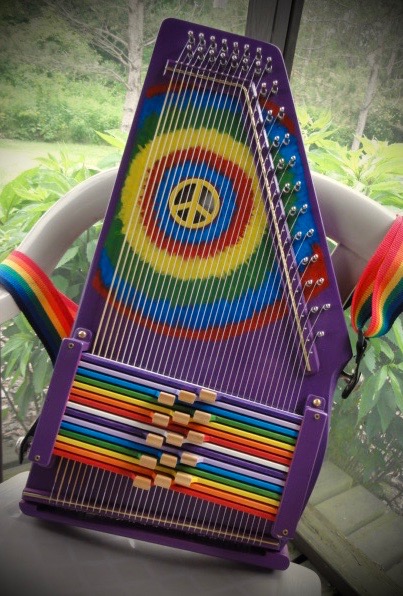 Our lives have changed a lot since then but there is still that old friend nostalgia. For me, it surfaces from time to time in the form of a rather whimsical creation like… this “Hippy ‘Harp”.
I built this autoharp for fun but it is for sale if anyone is interested. It “blew my mind” planning its appearance and thinking about the groovy old timey psychedelic music we might play with it.
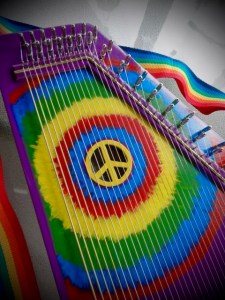
 Apart from the paint job, it differs little from my standard instrument. It’s a thirty-six string chromatic with fifteen thin chord bars painted in a rainbow pattern ( it might be said that all of the chords are “color chords”). The quiet chord bars are carried on #6 steel bridge pins driven into Delrin bases. Structurely, it features a laminated pin block frame, birch ply back, and a solid poplar soundboard. A peace symbol rosette is inlaid in the sound hole and an there is an additional sound hole in the back that makes the sound more audible to the player’s left ear and is useful for handling the instrument.
The base coats of purple enamel and the hand painted tie dye pattern are followed by multiple coats of semi-gloss lacquer.

 Fret Or Fret Not
You must be logged in to post a comment.