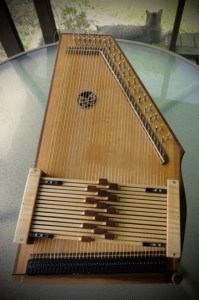
 The latest autoharp to emerge from my workshop is this thirty-seven string diatonic beauty ordered only two months ago by an autoharp friend named Lori. She currently plays chromatic autoharps and was amazed at the richer tone and greater volume of a two key diatonic. She often plays in the key of D with a dulcimer group but also finds the keys of G, C, and A useful. This diatonic is primarily set up for the keys of D and G but with the addition of a single F string can play the F chord needed for the key of C. The key of A is also present with the chords A, D, and a partial E7.
 Two of the fifteen chord bars are lockbars. They are fitted with small sliding Delrin locks on each end that slide under the chord bar holder caps. There is a G lockbar and a D lockbar. When locked down the bar mutes those notes not used in that key so they cannot be played accidentally.
The instrument is constructed on a very stable laminated maple frame with a Sitka spruce soundboard. Walnut side veneer covers the laminated frame and provides a harder edge protection for the softer spruce soundboard. Walnut was also used for the bridges, tail cover, bar holders, and the chord buttons.

Fifteen thin maple chord bars rest on combs made with Delrin bases, steel pins, and soft springs for close action and quiet play. The walnut covers are capped with curly maple lined with felt.
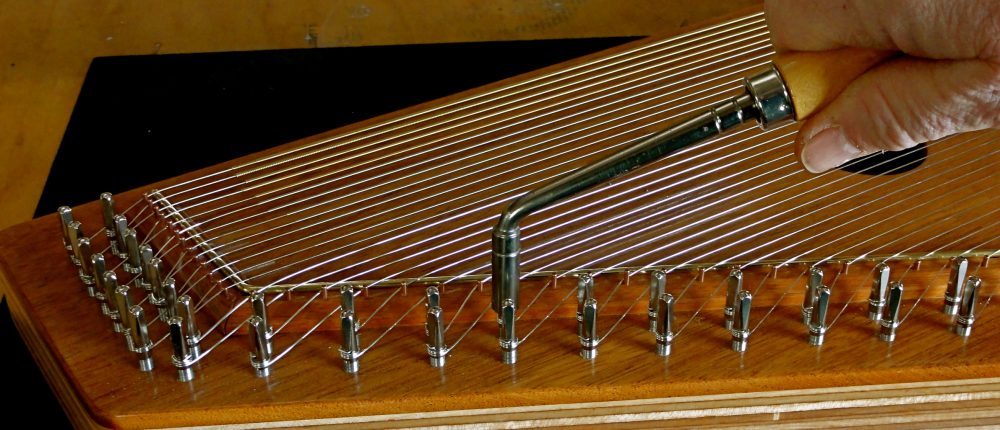
Daigle Flatline fine tuners and a custom set of Fladmark strings enhance the sound and tuning stability. The small knob on the bottom end of the tail piece is an on board allen wrench for the fine tuners.

In the laminated back of the autoharp is an additional sound hole that serves as a kind of “monitor”, sending the instruments sound to the players ear. This hole is also useful as a finger hold for handling and carrying.
 Fret Or Fret Not
You must be logged in to post a comment.