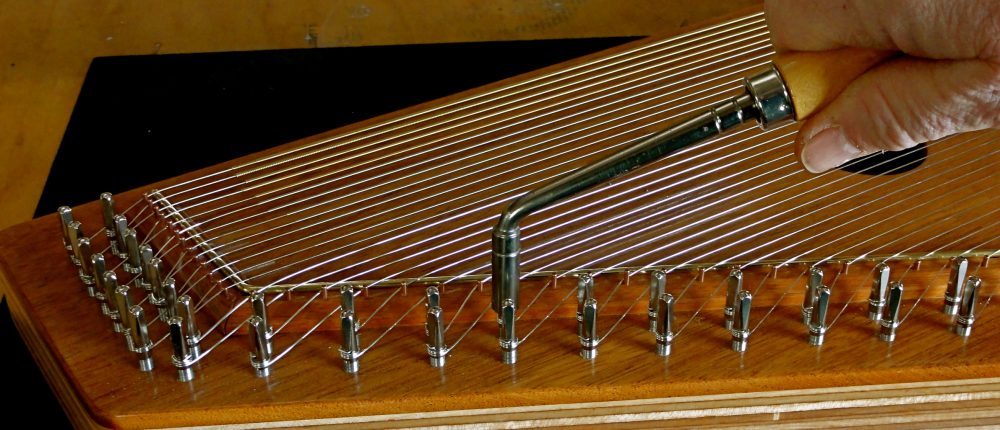
“Musicmakers” in Stillwater, Minnesota (https://www.harpkit.com) has been a source for musical instruments, kits, and supplies since 1978. Long ago I built (from scratch) a Celtic harp and an Autochord from their published blueprints and completed a couple of mountain dulcimer kits for owners who were unable to do so themselves. I have always appreciated the quality and innovation of Musicmakers’ work.
 Several years ago they produced their version of an autoharp and called it an “Autochord”. It was a unique design that differed from the more conventional Chromaharps and Oscar Schmidts. Thirty-eight ball end guitar strings spanned from bridge pins to an anchor end bridge made from a section of brass tubing. The chromatic tuning was scheduled from F2 to A5. The fifteen chord bars rested upon 1/8 Delrin rods drilled directly into the soundboard. The body of the instrument consisted of a 1/4″ redwood soundboard with a bass bar, a 3/8″ plywood back, and a laminated frame with gaps at each end of the long rail.
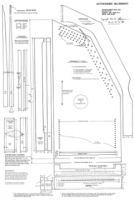 This interesting instrument was offered as an easy to assemble kit for someone with basic DIY skills. Like all of Musicmakers kits, it would, with attention to detail, bring satisfying results. The result however, was a rather large, heavy, and somewhat unconventional autoharp.
Although the Autochord has been discontinued for several years it still has a unique presence in the autoharp community. Musicmakers offers the plans and assembly instructions as a free download and sells the collated non-wood components needed to make the instrument. The downloaded files can be enlarged to full sized prints at a retail copy store and used as a pattern. It is a good resource for someone wanting to design or make their first autoharp or get a few ideas.
 This Autochord kit came to my workshop in the original shipping carton. It was purchased in 1995 and had only the soundboard and back glued to the frame. The current owner asked me to complete it and install fine tuners.
 I made several modifications to the original design. The Daigle fine tuner system came with its own bridge so I deleted the kit’s brass tube. The wound bass strings supplied were standard guitar strings that had windings their entire length. Greg Schreiber made a custom set of wound strings that had windings only within the speaking length of the strings. I substituted threaded adjustable bridge pins so I could accurately level the strings for effective damping.
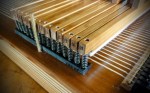 The design specified drilling the Delrin chord bar combs directly into the soundboard. Instead, I made separate Delrin bases that can be more easily adjusted for smoother chord bar movement.
 Fret Or Fret Not
You must be logged in to post a comment.