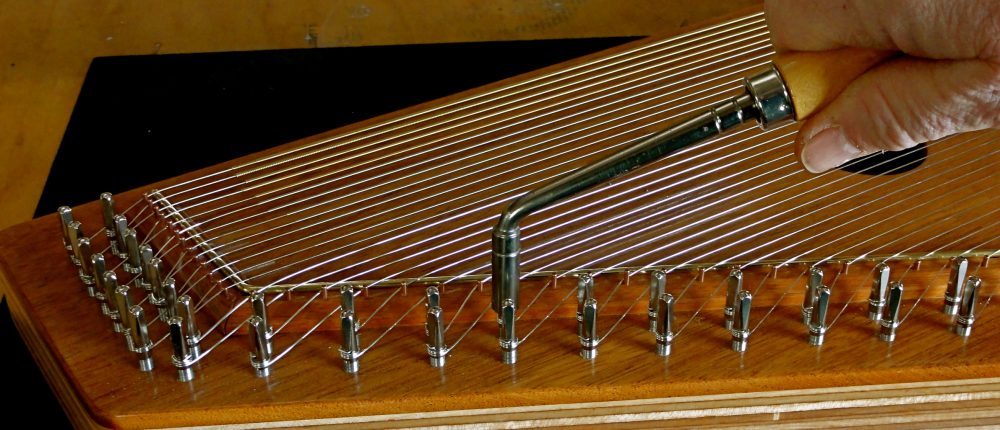
 I realize that the title of this post is kind of a stretch but it’s embarrassingly indicative of how my mind sometimes works. “My Name Is Morgan But It Ain’t J.P.” is an old time song that was covered by The New Lost City Ramblers. Mike Seeger, a member of the trio, famously owned and played an autoharp (not on that song) built by Tom Morgan of Morgan Springs, Tennessee. It was in admiration of Mike Seeger’s Morgan autoharp that prompted an Ohio musician to obtain the one I’m about to describe.
 Long story short…. this beautiful instrument arrived in 1980 fully finished but absent the chord bars. For various reasons Mr. Morgan could not complete the chord set but instead sent along sufficient rough stock of Brazilian rosewood for their fabrication. The instrument has slumbered peacefully and unplayed for over forty years until it came to my workshop last October.
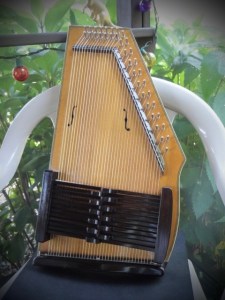
 There are several features that make this a very distinctive autoharp. The woods, spruce and Brazilian rosewood, were purchased by Mr. Morgan at auction from the C.F. Martin guitar company where they had been in storage since the 1940s. The one piece spruce soundboard carries two of Morgan’s trademark “f” holes and is carved into a gentle violin- like arch. Although I couldn’t observe them because of the size and location of the sound holes, there apparently exist an internal pre-stressed truss rod and tone bars that, with a stainless steel anchor end reinforcing plate, make this a very stable instrument.
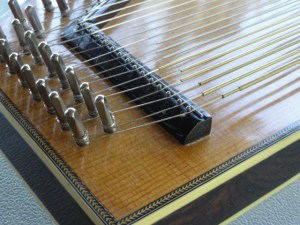 Although unplayed, the chromatic string set was forty years old and a little corroded. After much consideration it was decided to replace it with a scale designed for diatonic play in the keys of G and D. An optional F note replaces an F# in the scale to allow an F chord for play in the key of C. The chords were chosen based upon the songs that will be accompanied and extra stock was made into additional minor chords, two lock bars, and blank bars for future need.
 The twelve, 5/16 inch-wide chord bars are arranged in two rows as was probably the intention of the builder. They rest upon #6 steel pins driven into Delrin bases. The Seeger autoharp bore round buttons that were sometimes broken. These chord bars were fitted with comfortable dished trapezoidal buttons made of rosewood.
Since the owner requested that there would be no visible screws, I devised a means of anchoring each holder and its Delrin base together with only two invisible screws. To provide easy access to adjust and change out chord bars I made top covers held by internal and inlaid magnets.
 It was both an honor and a challenge completing this beautiful sounding instrument. Rosewood is a hard and oily wood that was not kind to tools and abrasives. I had some anxiety over making the most use of the limited and irreplaceable chord bar stock that was provided.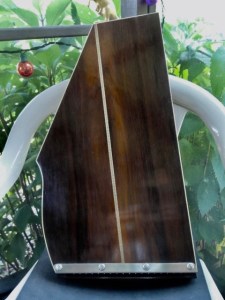
 Finally, after over forty years of initial correspondence with the instrument’s luthier Tom Morgan, weeks of consultation in my workshop, and even a global pandemic, the patient musician and his Morgan autoharp #80002 sing together.
 Fret Or Fret Not
You must be logged in to post a comment.