Some time ago, June 8th, 2018 to be precise, I posted here about one of my first “art ‘harps.” That autoharp creation was much like my usual custom instruments but (pun alert) highly decorated with a whimsical, tie-dyed, peace, and counter culture theme. It was quickly scooped up and shipped to a faraway continent where I hope that it is still singing amid the billabongs and coolabah trees.
Moving ahead to 2025, that first Hippy ‘Harp attracted the attention of a musician from New York who performs with autoharp and teaches music and theatre to children. She asked if I could recreate a version of that instrument.
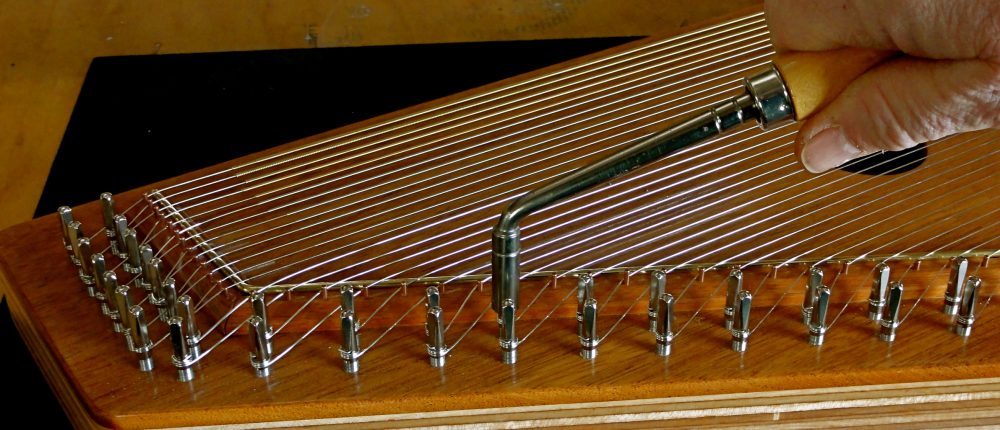
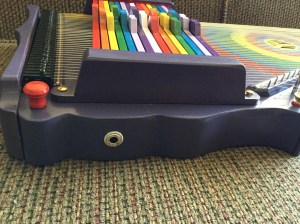
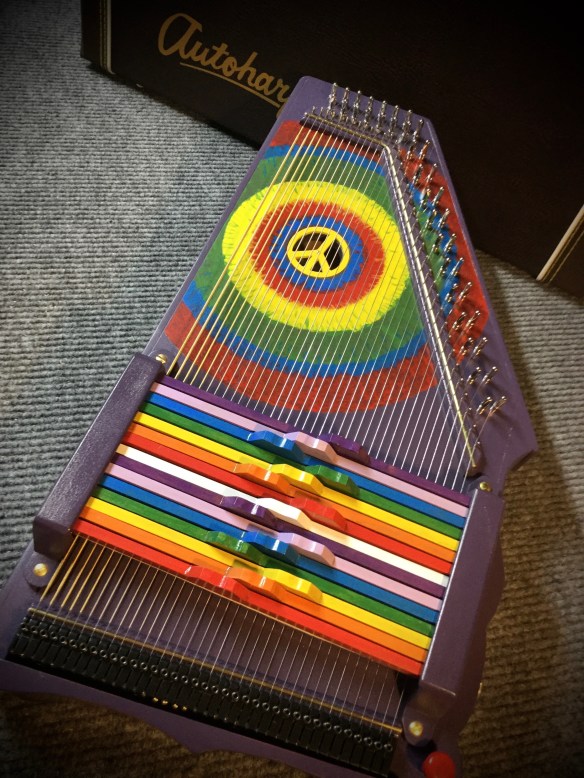 The appearance of the new Hippy ‘Harp is much the same as the original with a peace symbol rosette, tie-dyed paint job, and rainbow colored chord bars. This new version includes a solid cedar soundboard, Daigle fine tuners, and a Schreiber electromagnetic pickup.
What really sets this autoharp apart is the chord bar setup. I had begun building this instrument as a fifteen chord chromatic with the standard setup of major, minor, and seventh chords. At some point in the process I asked the musician if she might be interested in a chord system that I was just learning about, the PRIZIM.
The PRIZIM system was developed by Pennsylvanian autoharpist Loren Todd Crowley et al. With this intriguing design, a greater number of chords can be played by pressing two chord bars at a time. Hippy ‘Harp with standard chromatic tuning and fifteen conventional chord bars is mechanically the same as my other autoharps. The exception that makes this a PRIZIM is the patterns of open note cuts in each of the chord bar felts.
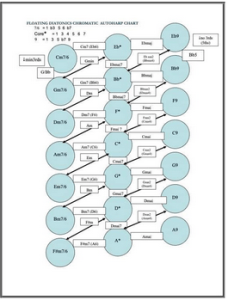
Online PRIZIM chart for 21 chord chromatic autoharp
The PRIZIM system can be adapted to almost any autoharp. Chord charts and cut patterns for twenty-one chord autoharps are available online. Because I was in the middle of building a fifteen chord instrument, I consulted with Loren for advice in using fewer bars. The result was a full compliment of two button chords in the keys of C, G, and D and dozens of combinations.
On paper, the PRIZIM’s unusual (to me) chord names and layout was confusing but once the instrument was set up, I could understand the logical layout and how easy it is to play. Chord names like stars, 6/7s, 9s, and add2s do not appear on any manufactured chord labels. For initial orientation I labeled the bars with basic chord names and provided the musician with a hand drafted chart. The experienced player should quickly grasp the logic of the system and will no longer need rely upon the labels.

 Fret Or Fret Not
You must be logged in to post a comment.