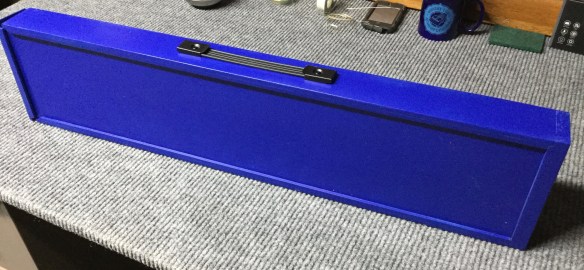
 After a long wait on my “to build” list, I made this travel dulcimer as a gift for a friend of mine. He had seen an instrument like this years ago and regretted that he didn’t purchase one before the luthier passed away in 2023.
The luthier, David Lynch from Indiana, designed and built a few of these travel dulcimers that were apparently sold to soldiers and Peace Corp volunteers to carry overseas. The ingenious design was a sturdy Appalachian dulcimer that was built into its own protective case. I had only seen one of David’s travel dulcimers once, years ago, and an online search turned up little reference to go on. This “one off” instrument involved some guesswork and interpretation.
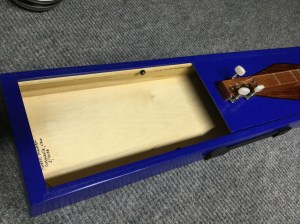
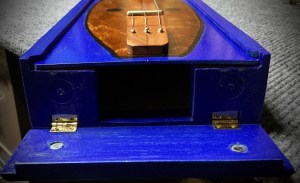 The top panel is removed by sliding it out of its channel, turned over, and returned revealing the three stringed dulcimer. Access is gained by opening a hinged door on the end of the case which is then held closed by magnets. The strings are tuned to the mode and key of choice with geared guitar style tuners. The fretboard is scaled to 23-3/8 inches and includes a 6-1/2 fret for 1-5-8 tuning (example: DAD).
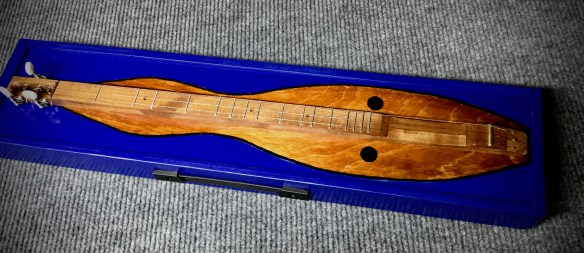 The frame of the case is made of lightweight poplar with panels made of 1/8 inch plywood. The mahogany fretboard is surrounded by a stained and painted hourglass dulcimer shape. The
 victim, er recipient of this unique gift is retired from the United States Air Force so the instrument is painted one of the several varieties of USAF blue.
 We recently visited The American Folk Music School/The National Dulcimer Museum in Trenton, Ohio. There, the owner/director Vickey Lovitt Sasser has curated a wonderful collection of Appalachian Mountain dulcimers and other stringed folk instruments. Spanning generations, over one hundred and thirty instruments tell the stories of dulcimers and their makers with examples from the early 19th century to contemporary builders.
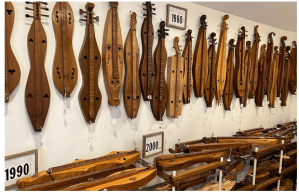 In my travels, I seek out museums that display stringed instruments and am often disappointed at meager offerings that are always behind glass. Here, we spent an enjoyable afternoon with the knowledgeable Ms Sasser examining the numbered instruments and reading about them in corresponding notebooks. Other patrons were sharing stories and some even brought their own acquisitions for Ms Sasser to identify.
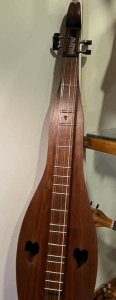 Each month the museum spotlights a dulcimer and this month it is one of mine! It seems like only forty-seven years, three months, and sixteen days since I created this all walnut hourglass dulcimer. How time flies! I am honored that one of my early dulcimers shares the museum with those of famous luthiers of the past and present.
 Fret Or Fret Not
You must be logged in to post a comment.