 The swarmandal is a plucked box zither of Indian origin and used as an accompanying instrument for the vocal classical music of Northern India. Modern swarmandals are similar to western zithers in shape and construction. In fact, autoharps with the chord bars removed are sometimes used as an equivalent instrument in India today.
These past few months I have been working with Purnash, a popular musician and multi-instrumentalist who performs in venues across Asia, the subcontinent, and beyond. We have combined our ideas to reinvent the swarmandal and build a hybrid that he has named “Raagaharp”. Raagaharp has a diatonic tuning schedule in the key of Eb for for his vocal range, and a combination of specially constructed lock bars for the deletion of specific notes within the immense variety of ragas he performs.
I am only familiar with western musical concepts as they apply to folk and old time music. I cannot understand or explain ragas. They are described as improvisations on a construct of modes, scales, and notes, each to affect the emotions of the listener…. and there are hundreds of them!
 The strings are played open. According to the musician, for a given raga he will mute some notes and re-tune some strings. He does this on-the-fly (imagine doing this between autoharp tunes!). To change the instrument’s setup between ragas, we arrived at the idea of a combination of fine tuners and lock bars.
 The lock bars of an autoharp function much like their adjoining chord bars… held aloft by springs when not in use and locked down by some sort of a wedge. The swarmandal’s lock bars will be swapped in and out as needed and seated, without springs, against the strings by a magnetic cover.
The fixture can hold one or two bars at once and also serves as a hand rest. Inlaid in the underside of the cover are two strong magnets for attachment. The cover is easily removed and replaced for changing out the bars.
 The bars are made of curly maple and felted in combinations of single and double notes. There are only seven notes in the scale but only six different notes will be muted since the keynote, Eb, will always be open. Six different bars are sufficient but I made an additional six bars with double notes.
 Autoharp chord/lock bars reside on the ‘harp and are seldom removed unless they need attention. The swarmandal’s lock bars will be constantly swapped in and out. To protect the fragile felt blocks I made a case to house the twelve+ bars and included extra felt for future wear.
 I included my usual tuning strip/duster that can be temporarily inserted underneath the strings as a guide for tuning. The strings are mostly in pairs and tuned to only seven notes. The notes are labeled on the strip and lock bars according to the Indian Solfeggio system….
Eb is S F is R G is G Ab is M Bb is P C is D D is N
I address musical notes as sharps and naturals from A to G. The completion of this task required some careful translation. For example, a note like Eb to me is D# but on the tuning strip it appears as S.
The musician finds the sound of most swarmandals to be unpleasant and for his custom instrument he requested a warmer, less brilliant sound, particularly in the treble area. I tried to accomplish this with an African mahogany soundboard and by using Delrin rod for the bridge caps. Delrin is a hard plastic material that will render less sustain than the harder brass rod that I usually use.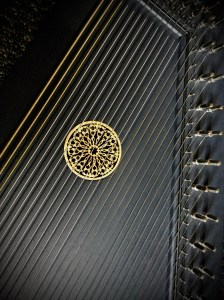
At his request, I applied a matte lacquer finish over a specially formulated Benjamin Moore color called “Hale Navy”. This color seems to appear blue under some lighting and black under others. Obtaining this color in spray form was pricey but the attractive appearance is worth the excessive cost.
I admit, there is little difference between this Indian zither and the autoharps that I have been building over the years. Creating this instrument and listening to Indian music has been a wonderful exposure to Eastern musical culture enabled by an amazing musician and new friend.
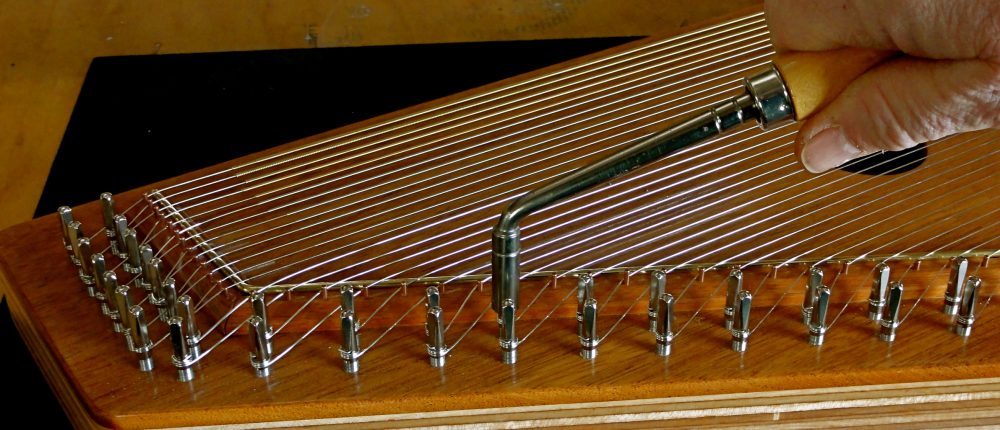
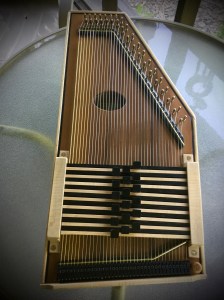 My latest commission comes from an autoharp musician/aficionado from New York State requesting a much deeper instrument with more resonance and a richer tone. Early planning was for a three inch depth but we finally settled on a depth of 2-1/2 inches to make an instrument you could really wrap your arms around. The working title became “ED”, standing for extra dimension.
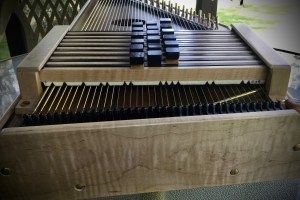 I began with my standard, one piece, pinblock frame which was extended in length to accommodate eighteen chords, an angled anchor bridge, and Daigle fine tuners. I added a 3/4 inch thick spruce spacer around the underside of the frame before attaching the soundboard, laminated back, and curly maple side veneer.
 Players with a shorter reach than this musician might find it difficult to play this deeper autoharp comfortably. To make the instrument narrower, I built it without the curved treble side that usually adds an inch of width. That, with lower chord bar covers, makes it easier to reach the buttons with the left hand.
 The solid cedar soundboard features an oval soundhole to round out the rich tone. The benefit of this deeper body with its larger internal capacity is greater volume and longer sustain.
 Having thirty-seven strings, this autoharp is set up in the single diatonic key of A. The eighteen chord bars are alternating natural maple and painted black. The musician wanted, of course, the chords in the key of A but also alternative chords that would have an ethereal feeling. For this he sought the advice of Jo Ann Smith who designs expert chord layouts and charts for cutting each individual chord. Ordinarily, a single key can be covered nicely with eight or ten chords. This instrument has fifteen chords with three additional blank bars to be cut when determined later.
 The solid spruce soundboard is colored with a blue aniline dye and decorated with a self adhesive overlay that features two dolphins leaping from the sea. The painted chord bars are profiled to resemble waves and the curly maple trim is dyed to match.
 The Okoume laminated back is painted using fish net as a stencil. A small soundhole/carry hole is decorated with a sort of alien jellyfish.
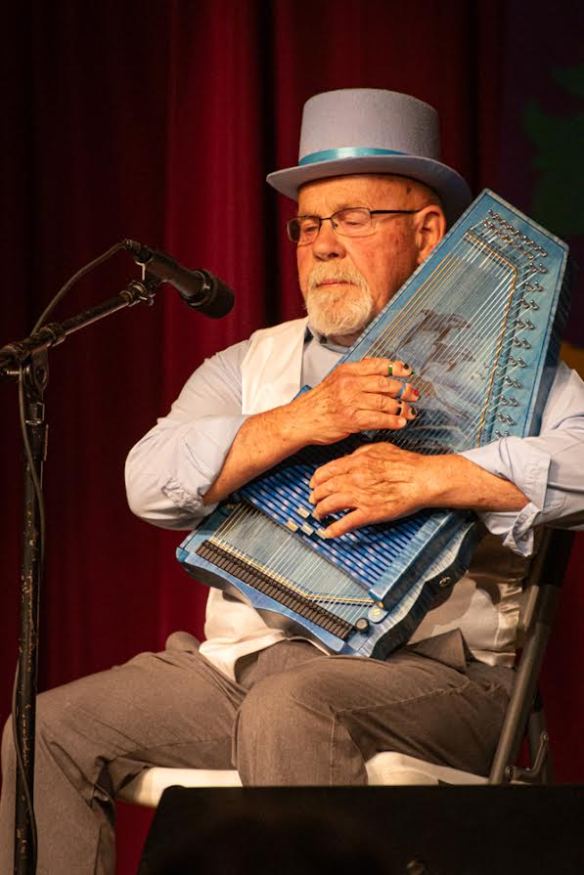 The happy owner, Rene St. Aubin, collected his new instrument at The Mountain Laurel Autoharp Gathering which takes place each year at a university in Shippensburg, Pennsylvania. An exciting feature of the Gathering is the MLAG Autoharp Championship Contest. US and international autoharp musicians travel there to compete in this juried competition. This year Rene was a contender.
 Here is a custom autoharp commissioned by a Michigan based musician who is also an Oscar Schmidt dealer. Her Etsy site, WellsPlace, features customized new and used autoharps, therapy harps and autoharp parts and accessories.
 Her new personal instrument is a thirty-seven string two key diatonic in the keys of C and G. The fifteen maple chord bars alternate in colors from natural to stained maple.
 A laser cut rosette trims the soundhole. The dragonfly is, to date, the most popular choice and has appeared on more than a dozen of my instruments.
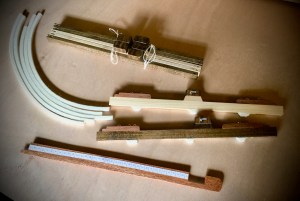 Included are C and G lock bars that can be swapped into the array as needed. The four blank chord bars and extra felt can be cut for additional chords as needed.
 The poplar soundboard and eight chord bars are colored burgundy with black for the remaining components. The finish is completed with several coats of satin lacquer.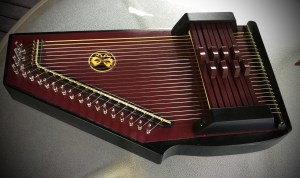
 A laser cut soundhole rosette is colored to resemble the Philodice butterfly that she uses as an online icon and identity.
 This twenty-three string diatonic in the keys of G and D is tuned from A3 to D6.
 Eight chord bars are carried upon combs with Delrin bases and #6 steel pins. This is an improvement over the slotted holders used in the past.
 It’s been some time since I weighed in on this kinda hybrid weblog/website. Weblogs beg frequent entries and websites contain information and the mechanics of the biz. I have been remiss in both. The daily statistics, when I check them, have been heartening and I truly appreciate the many visits. I have kept up with the frequent requests for information and advice but haven’t had a lot of new content to post about my work.
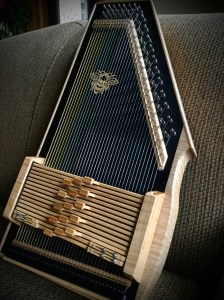 I built this F/C diatonic for a musician in New York state whose mother, by coincidence, resides here in Darke County. It was so nice that she traveled here to take delivery as it’s not often that I meet my clients face-to-face.
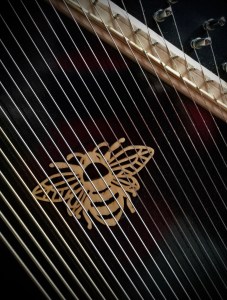 The musician’s name means “bee” so she requested and choose a bee as a soundboard rosette. As luck would have it, Etsy had a laser cut bee ornament of the appropriate size.
 Thirteen chords with two lock bars cover this two key arrangement. This “Bowers” setup has the majors in the center row, minors in the bottom row, and sevenths (+sus) in the top row.
 Daigle fine tuners with an onboard fine tuning wrench complete this very nice instrument.
 Along the way I have made a couple of improvements on my “Child ‘Harps”. I had been making slotted chord bar holders by cutting down the manufactured plastic holders once produced by Oscar Schmidt. These work well but are a bit noisy when the wooden bars “clack” against the hard plastic. My newer Child ‘Harps now have the quieter Delrin and steel pin combs as on my standard sized autoharps.
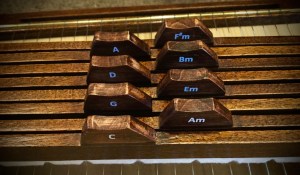 Child ‘Harps have carried seven chords in two rows. I now offer eight chords. Here is the G/D diatonic version.
 As with the Child ‘Harps’ larger siblings, laser cut sound hole rosettes are popular. there is a variety of styles available in this smaller size for this smaller autoharp.
 A more recent build is this thirty-six string, fifteen chord chromatic I built for a gentleman just beginning his autoharp journey. His preferences included a Celtic cross sound hole rosette, an all black finish, and a salvaged OS tuning label at the anchor end.
 This instrument resembles the old black model A autoharps of the past but features all of my modern improvements for tone, volume, stability, and play ability.
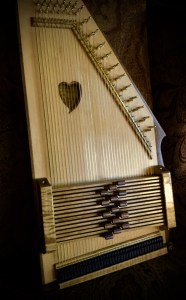 This thirty-seven string, fifteen chord diatonic autoharp plays in the keys of G and D. The Sitka spruce soundboard features a weeping heart sound hole and curly maple bridges. Walnut trims the sides, chord bar buttons, and tailpiece.
 The fifteen maple chord bars are arranged in a custom, three row layout.
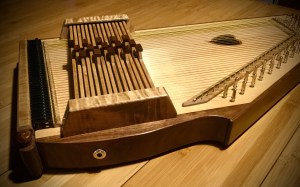 Added options are Daigle fine tuners and a Schreiber electromagnetic pickup.
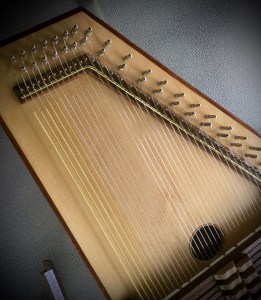 A musician from Tennessee recently commissioned this custom autoharp with several features that, to me, are very similar to the fifteen chord Oscar Schmidt and ChromaHarp models of the past. Over the years those A style chromatic models with their round sound holes, fifteen chord bars in two rows, and laminated soundboards underwent many improvements by their manufacturers. This musician seems to favor that style of instrument and was able to specify several construction, setup, and cosmetic improvements to suit his preferences and playing style.
 Most of my builds have been set up for playing in the area above the chord bars with the high treble strings unobstructed by the chord bar covers. This chord set is positioned closer to the tuning pins to permit play below the chord bars at the anchor end. Many of the old OS A models were arranged this way until playing the instrument upright became common and the bar set was moved south by their owners or the factories. This instrument is designed to be played on the musician’s lap with the left hand at the chords and the right hand playing near the anchor bridge.
 The old A models chord bars and buttons were 5/16 inches wide. I reduced these bars to a 1/4 inch width to narrow the array while leaving the buttons wide enough as to not require caps. The maple buttons are of a similar style to the older fifteen chord ‘harps and the chords are selected and arranged to the musician’s preference. He prefers a higher action (the height of the felt above the strings) for more vigorous chording. I set the travel high as requested but included extra self-sticking felt strips for under the covers should he choose to adjust the bars lower.
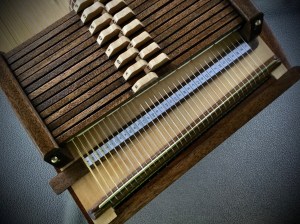 The modern improvements in the construction of this instrument include a solid spruce soundboard with tuned bracing, a one piece laminated frame, and quiet chord bars mounted on Delrin and steel pin combs. The chord bars, covers, side veneer, bridges, and tailpiece are made of African mahogany that has been stained dark brown. The musician requested that I not apply note labels under the tuning pins so I included a wooden tuning strip/duster that can be positioned under the strings to aid tuning.
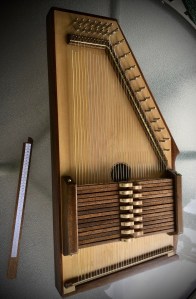 A custom built autoharp such as this can be built with the preferred features and options that improve playability and appearance. Sometimes it comes with a surprise: as the owner noted, “I was in shock at how light it is!”.
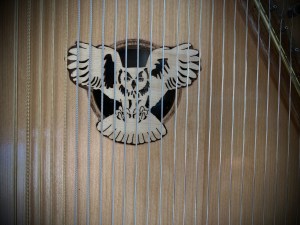 I have recently located a source of laser cut ornaments in a variety of subjects. Most are too large to inlay as a sound hole rosette but with many of them, I can trim away the bordering areas for a good fit.
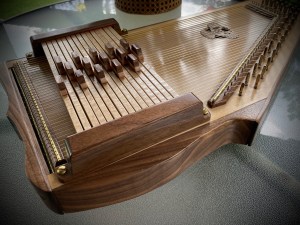
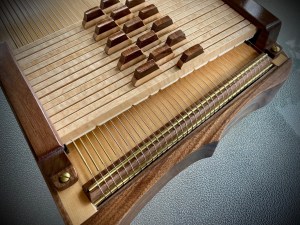
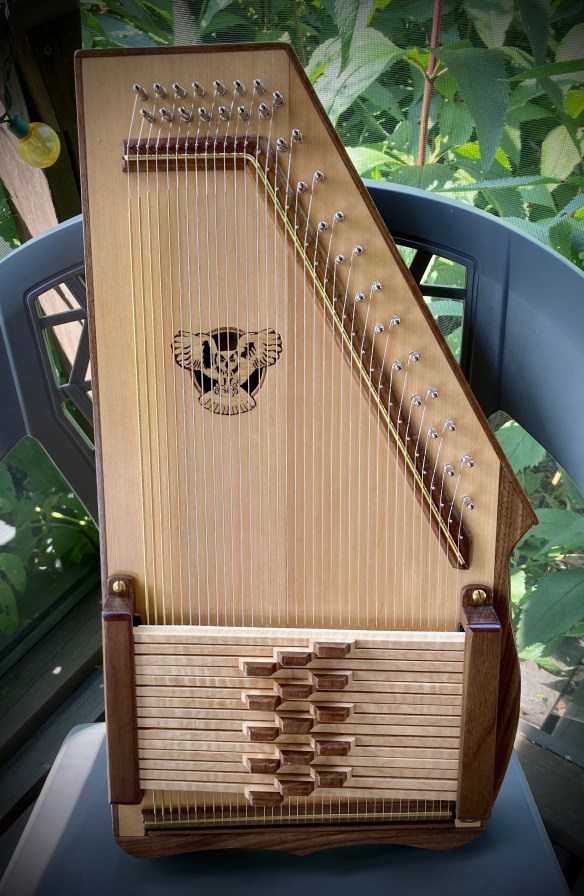 Here is a new custom thirty-six string chromatic autoharp. My standard, one piece pinblock frame features a spruce sound board, laminate back, and 3/16 inch thick walnut veneered sides. Matching walnut was also used for the brass rod-capped bridges, tail piece, chord bar covers, bridges and chord bar covers.
 The fifteen chord bars are made of curly maple. The contrasting buttons are capped with walnut.

 Fret Or Fret Not
You must be logged in to post a comment.