Soon may the Wellerman come, to bring us autoharps tea and rum…..
 As a landlocked luthier here in Ohio, I truly miss the ocean. Marsha and I have lived in a coastal town on the Great Barrier Reef. We have wandered beaches in Florida, Cape Cod, Oregon, Nova Scotia, Iceland, and Ireland. We even spent two months at sea working on a container ship that crossed both Tropics and the Equator. With only some photos and a smattering of shells to sustain our fading memories, I sometimes regret leaving those experiences behind for life in the flatlands.
Nothing pulls me out of the doldrums like a new, creative, and whimsical project. Something that swims against the tide. An idea that has been drifting around in the fog sounding the siren’s call……. seas the day! weigh anchor! come about!
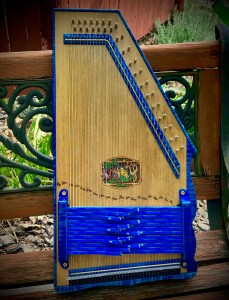
Then the wave hit me, an autoharp in the key of sea. To be more Pacific, a diatomaceous, er, diatonic autoharp in the single key of “C”.
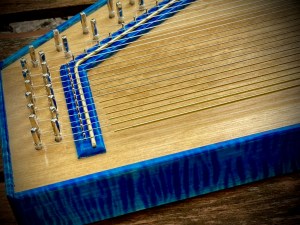
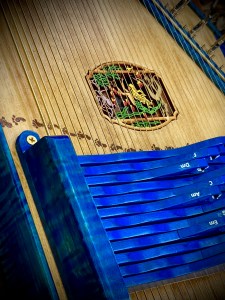
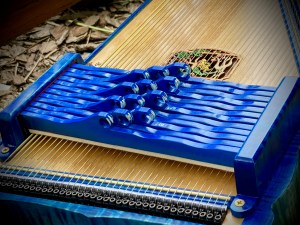 This thirty-seven string instrument has twelve chord bars shaped like waves. The three rows of buttons resemble white caps. Bridges, chord bar holders, tail cover, and side trim are made of curly maple dyed bright blue to show an iridescent, wave like grain.
 A laser cut rosette adorns the sound hole and bare footprints cross the sandy colored solid spruce soundboard.
 The laminated back has been painted bright blue using netting as a stencil. Captured in this fish net is a colorful jellyfish soundhole.
 Here is a new custom thirty-seven string chromatic autoharp that I built for a beginning autoharp musician here in Ohio. She plans to play worship and folk music to accompany herself and other vocalists. Because she resides within easy driving distance to Darke County, she and her husband could visit, view the many features and options available, and order the special instrument that is to be a birthday gift from her family.
 I always try to make each of my instruments unique so that my clients have a special instrument unlike any other. Of course there are constraints like scale, setup, and structure, but I like to give folks choices. This musician chose a western red cedar soundboard, maple chord bars, and curly cherry for the bridges, bar holders, buttons, and side trim.
 A weeping heart was chosen for the sound hole. I made this by inlaying a 1/8″ thick cherry heart shape into the 1/4″ thick soundboard and then removing the inner heart shape leaving a 1/8″ wide cherry border.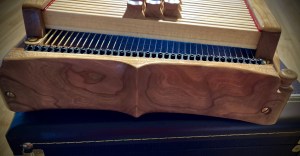
 The fifteen maple chord bars feature cherry buttons with the lateral dishing (rather than longitudinal dishing) preferred by the player. They move on #6 steel pins set into Delrin bases. The chord felt is yet uncut pending the player’s preferences.
 Structurally, this A style autoharp is built with a one piece laminated pinblock frame and a 1/4″ thick laminated birch back. Lately, I have been routing away unnecessary areas inside the frame to increase the interior volume. This, along with some tuned bracing, improves tone and volume.
 I recently completed is this thirty-seven string diatonic autoharp in the single key of A. I built it for ourselves because Marsha and I are trying to sing along with our instruments more and find that the key of A is a comfortable range for our voices. Being a single key diatonic, it has paired string courses in the middle octave and only the notes needed for chords in the key of A. This produces a very rich and full tone that works nicely for strumming accompaniment and playing melody.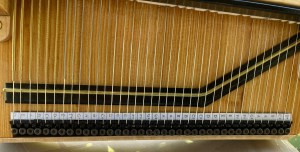
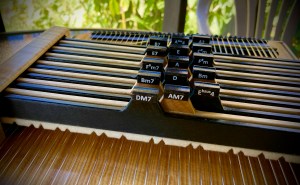 Fifteen chords are arranged in a “Bowers” type setup with major chords in the center row, sevenths in the top row, and minors in the bottom row. This familiar arrangement is in place on all of Marsha’s instruments and permits a sort of “motor memory” to kick in when she changes from one autoharp to another, even if in different keys. Seven of the chords are “color chords” for enhanced arrangements.
 The instrument has a 1/4 inch thick solid spruce soundboard. The one piece frame is laminated maple pinblock with a laminated maple back. The side veneer, end cover, and chord bar covers are made of curly maple. Chord bars are maple with alternate bars painted black. Black tuning pins, bridges, Schreiber fine tuners, and purfling complete the black/white motif.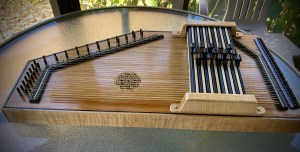
 My most recent instrument is this custom chromatic autoharp commissioned by a musician here in Ohio.
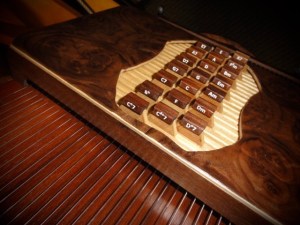 The twenty-one maple chord bars are capped with walnut buttons and are mounted upon combs made of #6 bridge pins and Delrin bases. Just to be different, I kinda hybridized the chord bar covers by making a shell out of walnut and very thin birch plywood. Its top surface is veneered with sequence-matched walnut burl. There is no distinct advantage for making it this way but the larger areas of felt damping on the underside seem to make the chord bars quieter.
 The side trim and bridges are walnut.
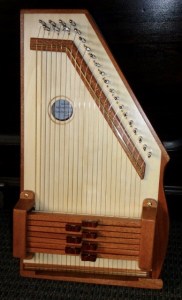
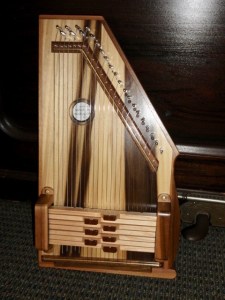
 I have recently completed three of my 3/4-size autoharps that are for sale and will soon be ready for delivery.
 The design and construction is fundamentally the same as my full sized instruments. For structural integrity and tuning stability I build with one- piece laminated frames, and solid wood soundboards and components. They have a rich full voice for their size and are built to last.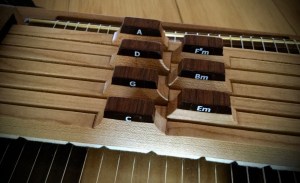


 Fret Or Fret Not
You must be logged in to post a comment.