“This is the dawning of the Age of A-harpius”
Autoharps come in varied sizes, some are as long as the Guitaro and some are wider with as many as forty-five strings. Most have a depth of around 1″ to 1-3/4 inches.
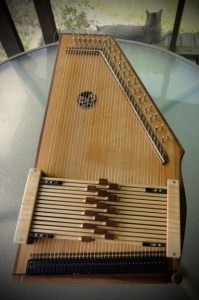
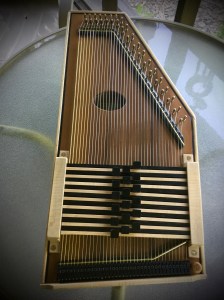 My latest commission comes from an autoharp musician/aficionado from New York State requesting a much deeper instrument with more resonance and a richer tone. Early planning was for a three inch depth but we finally settled on a depth of 2-1/2 inches to make an instrument you could really wrap your arms around. The working title became “ED”, standing for extra dimension.
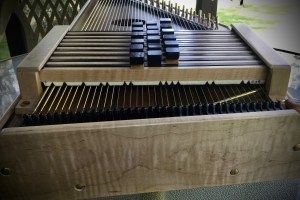 I began with my standard, one piece, pinblock frame which was extended in length to accommodate eighteen chords, an angled anchor bridge, and Daigle fine tuners. I added a 3/4 inch thick spruce spacer around the underside of the frame before attaching the soundboard, laminated back, and curly maple side veneer.
 Players with a shorter reach than this musician might find it difficult to play this deeper autoharp comfortably. To make the instrument narrower, I built it without the curved treble side that usually adds an inch of width. That, with lower chord bar covers, makes it easier to reach the buttons with the left hand.
 The solid cedar soundboard features an oval soundhole to round out the rich tone. The benefit of this deeper body with its larger internal capacity is greater volume and longer sustain.
 Having thirty-seven strings, this autoharp is set up in the single diatonic key of A. The eighteen chord bars are alternating natural maple and painted black. The musician wanted, of course, the chords in the key of A but also alternative chords that would have an ethereal feeling. For this he sought the advice of Jo Ann Smith who designs expert chord layouts and charts for cutting each individual chord. Ordinarily, a single key can be covered nicely with eight or ten chords. This instrument has fifteen chords with three additional blank bars to be cut when determined later.
 Here is a custom autoharp commissioned by a Michigan based musician who is also an Oscar Schmidt dealer. Her Etsy site, WellsPlace, features customized new and used autoharps, therapy harps and autoharp parts and accessories.
 Her new personal instrument is a thirty-seven string two key diatonic in the keys of C and G. The fifteen maple chord bars alternate in colors from natural to stained maple.
 A laser cut rosette trims the soundhole. The dragonfly is, to date, the most popular choice and has appeared on more than a dozen of my instruments.
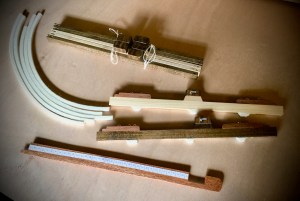 Included are C and G lock bars that can be swapped into the array as needed. The four blank chord bars and extra felt can be cut for additional chords as needed.
 It’s been some time since I weighed in on this kinda hybrid weblog/website. Weblogs beg frequent entries and websites contain information and the mechanics of the biz. I have been remiss in both. The daily statistics, when I check them, have been heartening and I truly appreciate the many visits. I have kept up with the frequent requests for information and advice but haven’t had a lot of new content to post about my work.
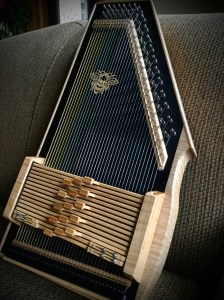 I built this F/C diatonic for a musician in New York state whose mother, by coincidence, resides here in Darke County. It was so nice that she traveled here to take delivery as it’s not often that I meet my clients face-to-face.
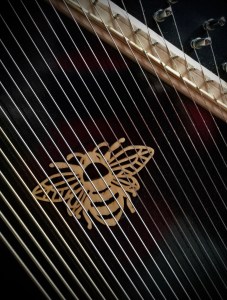 The musician’s name means “bee” so she requested and choose a bee as a soundboard rosette. As luck would have it, Etsy had a laser cut bee ornament of the appropriate size.
 Thirteen chords with two lock bars cover this two key arrangement. This “Bowers” setup has the majors in the center row, minors in the bottom row, and sevenths (+sus) in the top row.
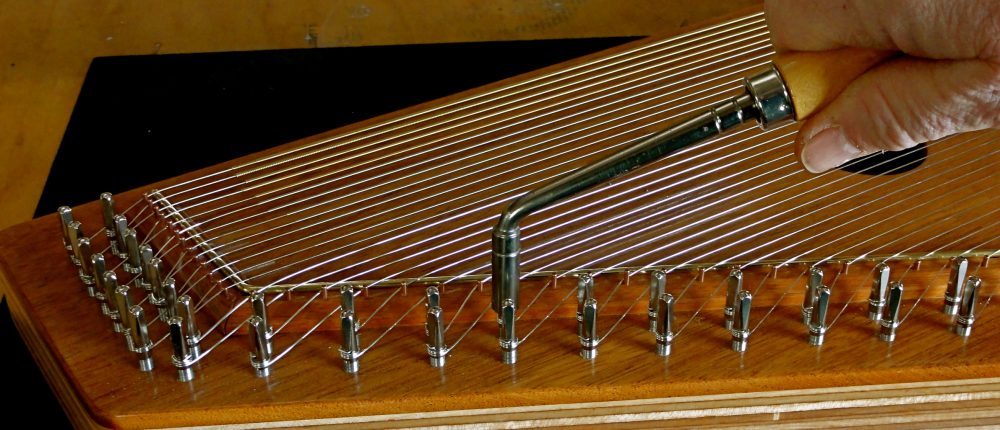
 Daigle fine tuners with an onboard fine tuning wrench complete this very nice instrument.
 Along the way I have made a couple of improvements on my “Child ‘Harps”. I had been making slotted chord bar holders by cutting down the manufactured plastic holders once produced by Oscar Schmidt. These work well but are a bit noisy when the wooden bars “clack” against the hard plastic. My newer Child ‘Harps now have the quieter Delrin and steel pin combs as on my standard sized autoharps.
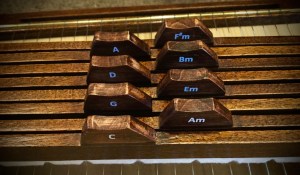 Child ‘Harps have carried seven chords in two rows. I now offer eight chords. Here is the G/D diatonic version.
 As with the Child ‘Harps’ larger siblings, laser cut sound hole rosettes are popular. there is a variety of styles available in this smaller size for this smaller autoharp.
 A more recent build is this thirty-six string, fifteen chord chromatic I built for a gentleman just beginning his autoharp journey. His preferences included a Celtic cross sound hole rosette, an all black finish, and a salvaged OS tuning label at the anchor end.
 This instrument resembles the old black model A autoharps of the past but features all of my modern improvements for tone, volume, stability, and play ability.
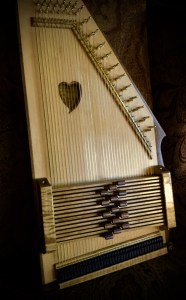 This thirty-seven string, fifteen chord diatonic autoharp plays in the keys of G and D. The Sitka spruce soundboard features a weeping heart sound hole and curly maple bridges. Walnut trims the sides, chord bar buttons, and tailpiece.
 The fifteen maple chord bars are arranged in a custom, three row layout.
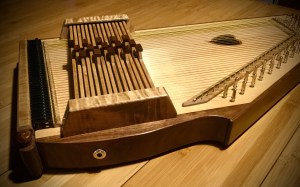 Added options are Daigle fine tuners and a Schreiber electromagnetic pickup.
 I recently completed is this thirty-seven string diatonic autoharp in the single key of A. I built it for ourselves because Marsha and I are trying to sing along with our instruments more and find that the key of A is a comfortable range for our voices. Being a single key diatonic, it has paired string courses in the middle octave and only the notes needed for chords in the key of A. This produces a very rich and full tone that works nicely for strumming accompaniment and playing melody.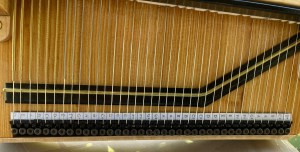
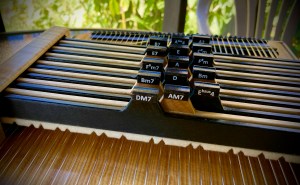 Fifteen chords are arranged in a “Bowers” type setup with major chords in the center row, sevenths in the top row, and minors in the bottom row. This familiar arrangement is in place on all of Marsha’s instruments and permits a sort of “motor memory” to kick in when she changes from one autoharp to another, even if in different keys. Seven of the chords are “color chords” for enhanced arrangements.
 The instrument has a 1/4 inch thick solid spruce soundboard. The one piece frame is laminated maple pinblock with a laminated maple back. The side veneer, end cover, and chord bar covers are made of curly maple. Chord bars are maple with alternate bars painted black. Black tuning pins, bridges, Schreiber fine tuners, and purfling complete the black/white motif.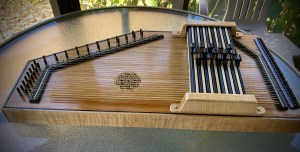
 I have recently completed three of my 3/4-size autoharps that are for sale and will soon be ready for delivery.
 The design and construction is fundamentally the same as my full sized instruments. For structural integrity and tuning stability I build with one- piece laminated frames, and solid wood soundboards and components. They have a rich full voice for their size and are built to last.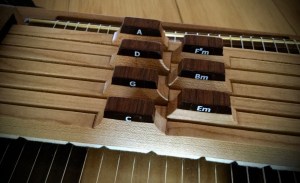


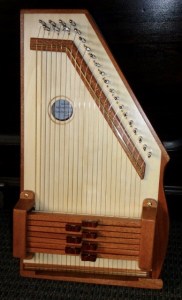
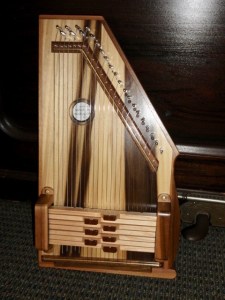
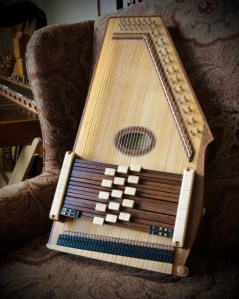 I recently completed and delivered this commissioned instrument to a musician in New York state. After the initial contact and much discussion by e-mail, the entire process required only three months. The wait probably seemed longer to the musician anxious to receive his first luthier built autoharp but its completion was well within my usual two to five month time estimate.

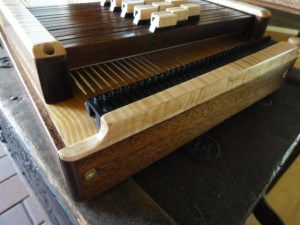 The chord bars, bridges, side veneer, chord bar covers, and tail cover are made of African mahogany stained with Minwax red mahogany oil stain. The chord bar covers, chord buttons, and tail cover are capped with curly maple finished natural. The soundboard is spruce, the back is maple veneer, and everything is finished with up to six coats of semi-gloss Deft lacquer.
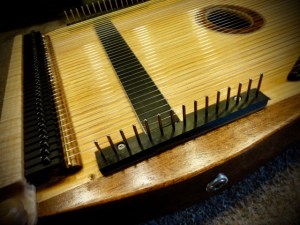 The Schreiber electromagnetic pickup is specially wound for this thirty-seven string array and is fastened underneath the chord bars by metal tabs that fit in slots on the underside of the Delrin chord bar combs. A small length of coax is routed through the inside of the instrument to a 1/4″ jack.
 Many of my autoharps are shipped out of state and abroad to musicians who will likely want to experiment with alternative chords or attend to future DIY adjustments and repairs. For this I include some extra blank felted chord bars, extra chord felt, self adhesive under cover felt, and extra springs. The wrapper from the custom string set will help them order the proper strings when it becomes necessary and a laminated strip indicates the tuning of each string. Also included is the allen wrench that comes with the fine tuners and a new star tipped T-wrench.
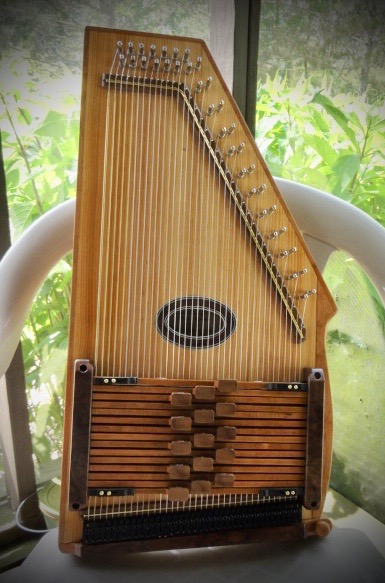 The latest from here at Fretnot Laboratories is this custom thirty-seven string, fifteen bar diatonic in the keys of G and D. It features Daigle fine tuners, two lock bars, flat chord bar buttons, and five extra blank chord bars for future substitutions. A custom oval rosette was fashioned using walnut burl and plastic white-black-white purfling. Walnut burl also trims the tops of the chord bar covers and the tail end cover.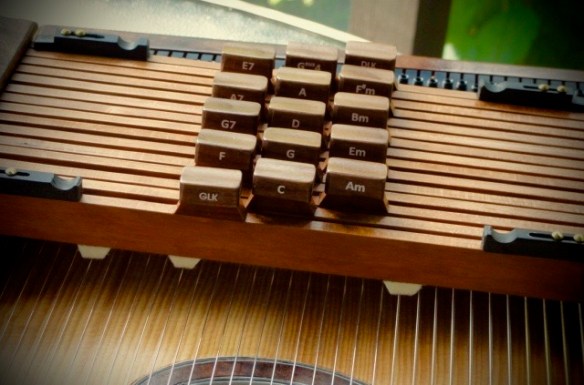
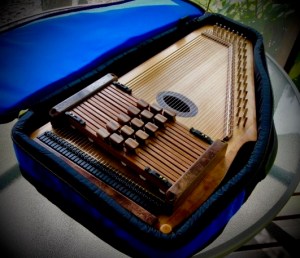
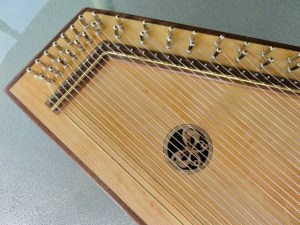 The latest autoharp to emerge from my workshop is this thirty-seven string diatonic beauty ordered only two months ago by an autoharp friend named Lori. She currently plays chromatic autoharps and was amazed at the richer tone and greater volume of a two key diatonic. She often plays in the key of D with a dulcimer group but also finds the keys of G, C, and A useful. This diatonic is primarily set up for the keys of D and G but with the addition of a single F string can play the F chord needed for the key of C. The key of A is also present with the chords A, D, and a partial E7.
 Two of the fifteen chord bars are lockbars. They are fitted with small sliding Delrin locks on each end that slide under the chord bar holder caps. There is a G lockbar and a D lockbar. When locked down the bar mutes those notes not used in that key so they cannot be played accidentally.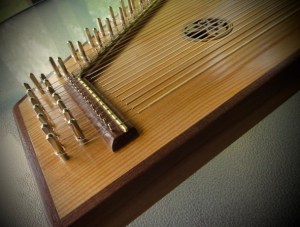


 Fret Or Fret Not
You must be logged in to post a comment.