Nearly two years ago I received a commission from a multi-instrumentalist in Nashville Tennessee. We were to invent a unique new instrument based upon the Marxophone.
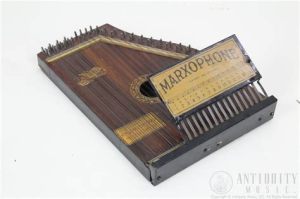 The Phonoharp Company’s Marxophone was an early 20th century fretless zither that was played with a system of spring steel hammers. The instrument played two octaves in the key of C. Typically, the right hand would play paired melody strings with the individual hammers and the left hand would strum four sets of accompanying chords. A single tap of a hammer would produce a single note. By holding the hammer down, the hammer would bounce on the string pair producing a mandolin type tremolo.
The musician wanted an instrument with this unique sound for his session work and the movies that he scores. For me, this was an engaging creative challenge combining my autoharp and hammered dulcimer knowledge with designs and materials I have never before contemplated.
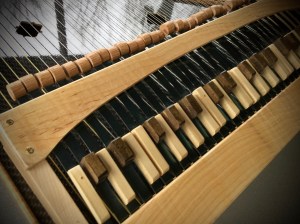
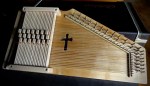
 Unlike the Marxophone, this instrument was to have no chords, only the hammered melody strings. While the Marxophone had two octaves tuned to a diatonic scale in the key of C, this instrument has three octaves tuned chromatically from C3 to C6. Being diatonic, the Marxophone had a single row of “keys”. This chromatic instrument has two rows set up somewhat like a piano keyboard with the bottom row for the naturals and the top row for the sharps.
Designing this from scratch without extant examples was a challenge to say the least. The construction of the body was much like building a large heavy autoharp. Laying out the string array involved the spacing of sixty-four strings so that the keys would be comfortable to play and the brute wouldn’t be too large to handle. It was necessary to keep the speaking length of C6 (from bridge to bridge) around eight inches to prevent breakage at that pitch, and eighteen inches was determined to be the optimum length for the longer bass strings, again to keep the instrument a more manageable size.
Scale calculations were preformed by the string maker, Greg Schreiber. Pitch and string length are considered when calculating the optimal diameter and tension for each note. The string pairs from C4 to C6 are plain wire. The bass octave, C3 to B3, is single wound strings designed with windings only between the bridges. With the average string tension of the 64 strings being 45 pounds, the total tension that the structure must bear is 2795 pounds.
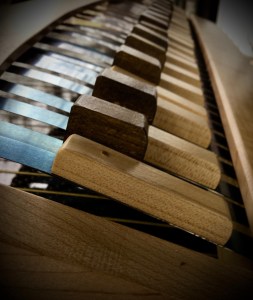 Oh My!…. now the hammers….designing them was the most difficult tedious issue here involving countless hours of “trial and error” to achieve the desirable degree of “bounce” and a more consistent feel between the two rows of keys. Coils and coils of spring steel were evaluated for their flexibility and resiliance. Dozens and dozens of hammers died in the quest to success. A complete two octave prototype instrument was sent to the musician for evaluation. Sound files were sent and finally the problem of bounce was solved.
 The hammer heads are slices of 5/8″ oak rod. The full length of spring steel for each hammer is 3/8″ wide by .005″ thick. Five thousands inch thick spring steel of this width is so flexible that it makes me think….. “thick foil”. To remedy some of the droop, it’s reinforced underneath by a section of .008 that is terminated just beyond the key.
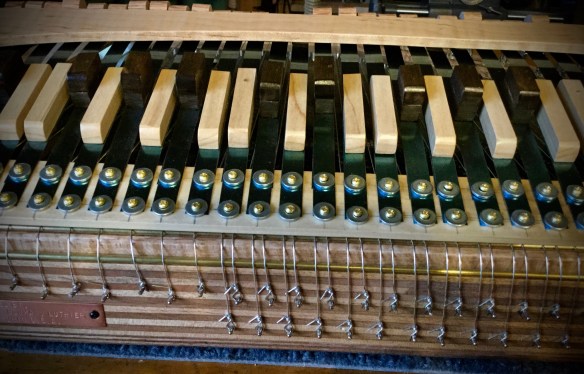
The hammers are mounted on a rail near the anchor end of the body. Two screws secure each hammer and allow for alignment with its string course. The flexible hammers are mounted at an angle that permits the head to swing freely between the string course and the upper stop bar. The underside of the stop bar is padded with two layers of felt to suppress the noise as each hammer bounces up.
 The strong, one piece maple pinblock frame is backed with 6mm Okoume plywood. A carbon fiber soundboard has a (pun alert!) striking appearance as well as sound. The sides, bridges, covers, keys, and trim are curly soft maple.
About The “Cryptoclavier” Name
 The musician is invested in cryptocurrency, particularly in Bitcoin. A clavier is a keyboard instrument with strings.
In addition to the many domestic and international venues where he performs, he hopes to entertain at cryptocurrency events. Embedded in the sides of Cryptoclavier are two Bitcoin medallions showing both front and back sides.
 The back side reveals a QR-code. To show their appreciation, event participants can scan and tip with Bitcoin.
This has been a challenging and fascinating collaboration with a creative multi-instrumentalist. I for one will be listening to movie scores and watching for YouTube videos hoping to hear this unique, one-of-a-kind Cryptoclavier.
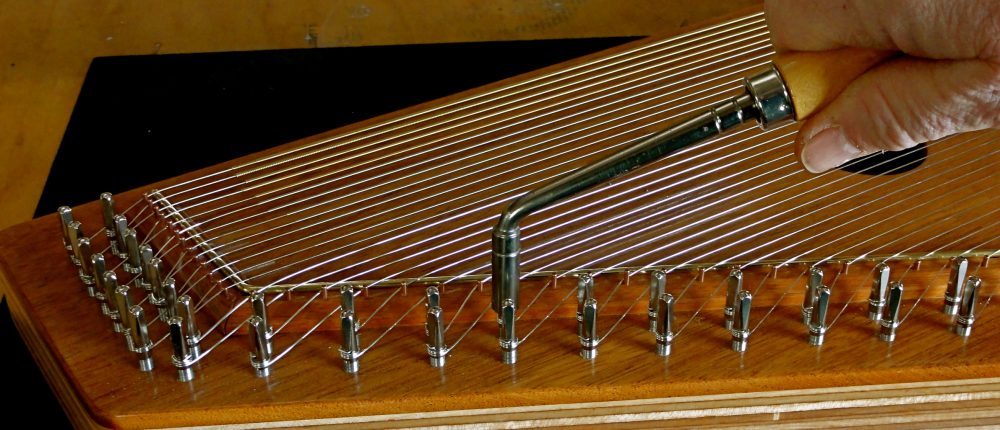
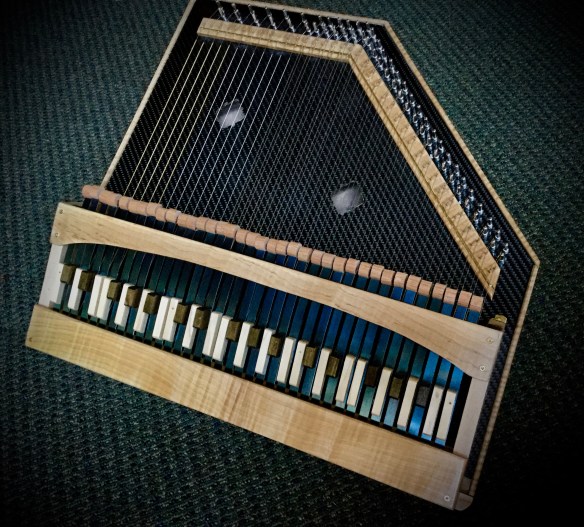 Last April I posted about the CryptoClavier, a large three octave chromatic keyboard zither that was based upon the 19th century Marxophone. This unique instrument was born from the imagination of Nashville, Tennessee musician Rory Hoffman who commissioned me to design and build it. To learn more about it you may refer to my April 2, 2025 post on this site.
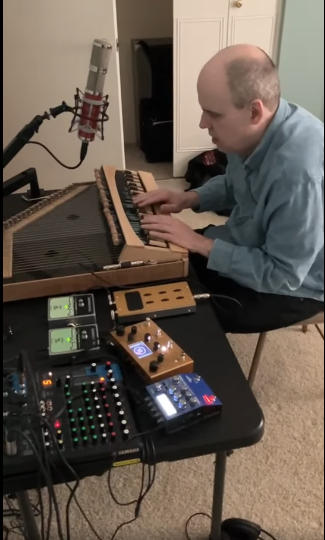 Rory Hoffman is a session musician who scores movies, plays backup on other musicians’ recordings, and performs in many local as well as worldwide venues.
 I’m looking forward to his video introduction of CryptoClavier. He has even reported that CryptoClavier will be heard on Ringo Starr’s new album to be released this April.
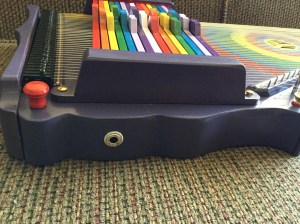
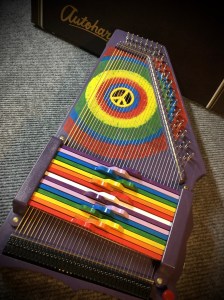
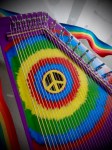
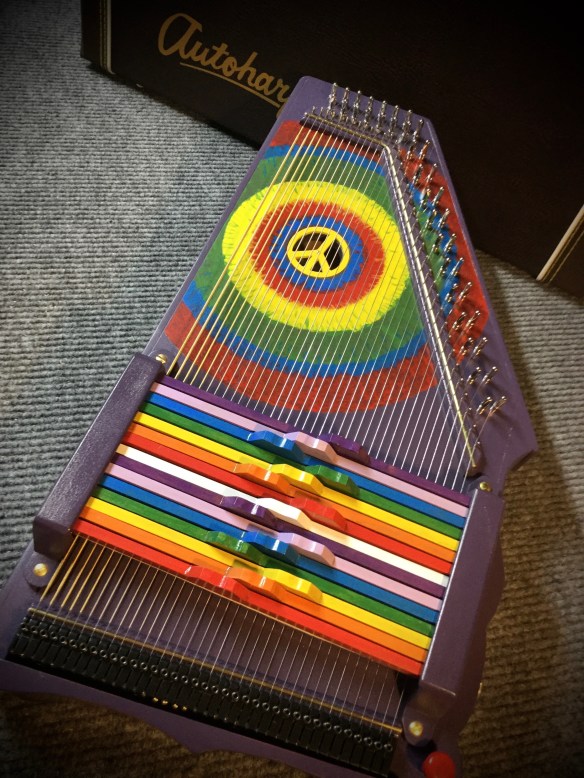 The appearance of the new Hippy ‘Harp is much the same as the original with a peace symbol rosette, tie-dyed paint job, and rainbow colored chord bars. This new version includes a solid cedar soundboard, Daigle fine tuners, and a Schreiber electromagnetic pickup.

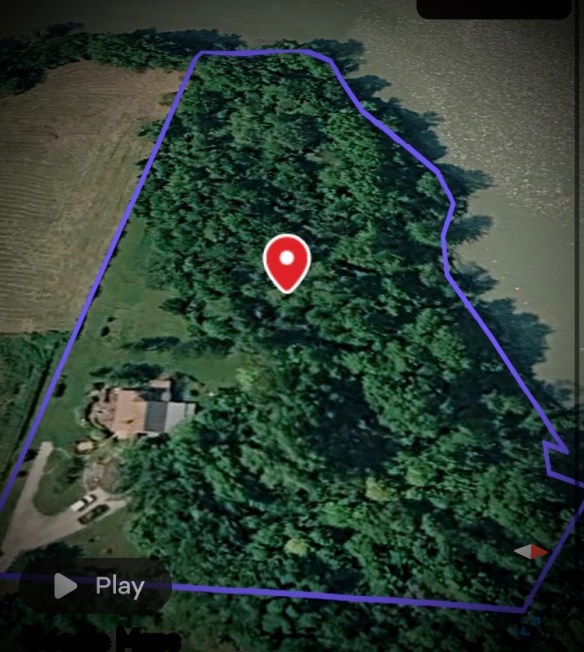 For the past 40+ years we have lived in rural Darke County Ohio along the head waters of the Wabash River. From time to time we’ve viewed satelite photos only to see a greyscale images of our wooded three acre property between farm fields and the river reservoir.
 This site has been waiting way too long for an update. In the months preceeding the present we have moved from our self-built home and workshop of 40+ years to the home and town that I grew up in. We often quip that we have “downsized” to a bigger house.
 This conversion is a pristine Oscar Schmidt model B with the chord bars removed. Because the new tuning schedule differs from the standard chromatic scale, a new schedule was calculated and a string set made for the precise diameters and tensions of each pitch.
 The swarmandal is a plucked box zither of Indian origin and used as an accompanying instrument for the vocal classical music of Northern India. Modern swarmandals are similar to western zithers in shape and construction. In fact, autoharps with the chord bars removed are sometimes used as an equivalent instrument in India today.
 The strings are played open. According to the musician, for a given raga he will mute some notes and re-tune some strings. He does this on-the-fly (imagine doing this between autoharp tunes!). To change the instrument’s setup between ragas, we arrived at the idea of a combination of fine tuners and lock bars.
 The lock bars of an autoharp function much like their adjoining chord bars… held aloft by springs when not in use and locked down by some sort of a wedge. The swarmandal’s lock bars will be swapped in and out as needed and seated, without springs, against the strings by a magnetic cover.
 The bars are made of curly maple and felted in combinations of single and double notes. There are only seven notes in the scale but only six different notes will be muted since the keynote, Eb, will always be open. Six different bars are sufficient but I made an additional six bars with double notes.
 Autoharp chord/lock bars reside on the ‘harp and are seldom removed unless they need attention. The swarmandal’s lock bars will be constantly swapped in and out. To protect the fragile felt blocks I made a case to house the twelve+ bars and included extra felt for future wear.
 I included my usual tuning strip/duster that can be temporarily inserted underneath the strings as a guide for tuning. The strings are mostly in pairs and tuned to only seven notes. The notes are labeled on the strip and lock bars according to the Indian Solfeggio system….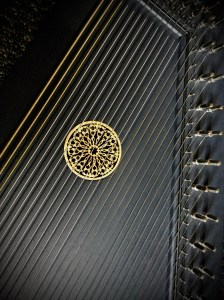
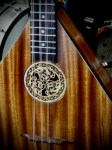
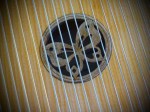
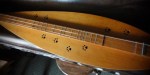
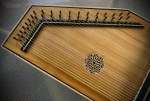
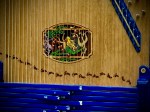
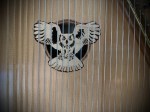
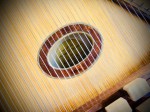
 Apertures (sound holes) in stringed musical instruments have been studied, experimented with, and designed for a variety of acoustic functions and characteristics. While a sound hole’s size, shape, and position certainly influence tone and volume, its appearance is what catches the eye and creates a kind of identity.










 And a dream it was! As I slept, a small crew (elves?) assisted me with some of the more tedious tasks of autoharp construction. Alas, they had disappeared by morning, never to return. I would like to believe that they responded to some of the many help wanted signs posted in our area and found employment with fair compensation, benefits, and a living wage for their important work.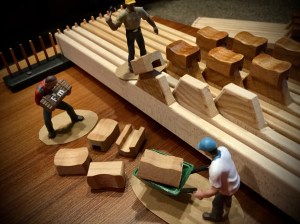
 I recently completed is this thirty-seven string diatonic autoharp in the single key of A. I built it for ourselves because Marsha and I are trying to sing along with our instruments more and find that the key of A is a comfortable range for our voices. Being a single key diatonic, it has paired string courses in the middle octave and only the notes needed for chords in the key of A. This produces a very rich and full tone that works nicely for strumming accompaniment and playing melody.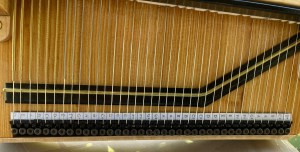
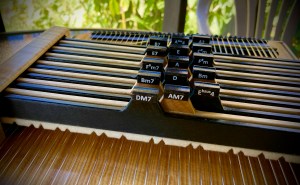 Fifteen chords are arranged in a “Bowers” type setup with major chords in the center row, sevenths in the top row, and minors in the bottom row. This familiar arrangement is in place on all of Marsha’s instruments and permits a sort of “motor memory” to kick in when she changes from one autoharp to another, even if in different keys. Seven of the chords are “color chords” for enhanced arrangements.
 The instrument has a 1/4 inch thick solid spruce soundboard. The one piece frame is laminated maple pinblock with a laminated maple back. The side veneer, end cover, and chord bar covers are made of curly maple. Chord bars are maple with alternate bars painted black. Black tuning pins, bridges, Schreiber fine tuners, and purfling complete the black/white motif.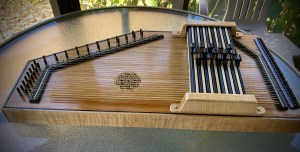
 Fret Or Fret Not
You must be logged in to post a comment.