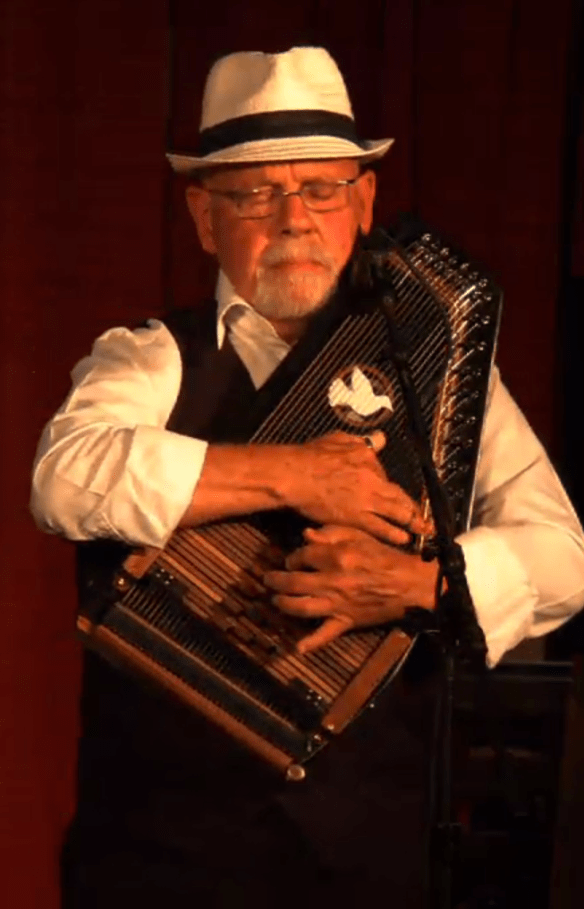
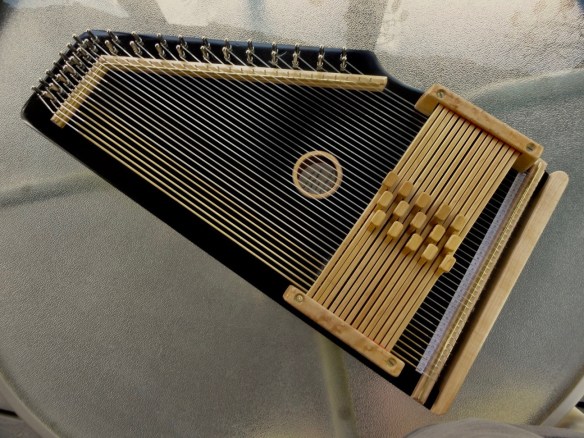
 Here is a new custom autoharp commissioned by a musician and performer from Ontario. He desired a bright white “dove of peace” shaped sound hole on an all black body. The dove shape that he chose was too delicate to cut into the soundboard so I inlayed it in a walnut veneer ring with a bright white plastic material.
The opaque black body finish was a learning experience for me as I have always finished my instruments to show the natural woodgrain. Wood finishing requires a lot of between-the-coats sanding and with an opaque finish it’s possible to sand right through to the bare wood. To avoid this potential problem I dyed the wood black, applied multiple coats of black grain filler and lacquer, and followed with several coats of satin lacquer. A satin finish was preferred over a gloss finish in the hope that the unavoidable fingerprints and chord felt dust would not be as visible.
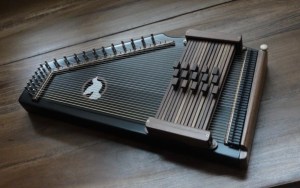 Walnut was the choice for the bridges, chord bars, chord bar buttons, bar comb covers, and tailpiece. Along with the brass hardware it makes for a subtle contrast to the solid black body.
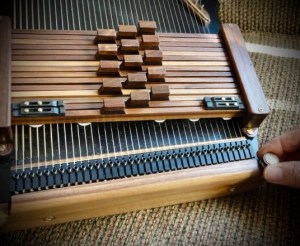
Black delrin locks on the ends of the lockbars. The bar is pressed and the locks slide to wedge under the covers.
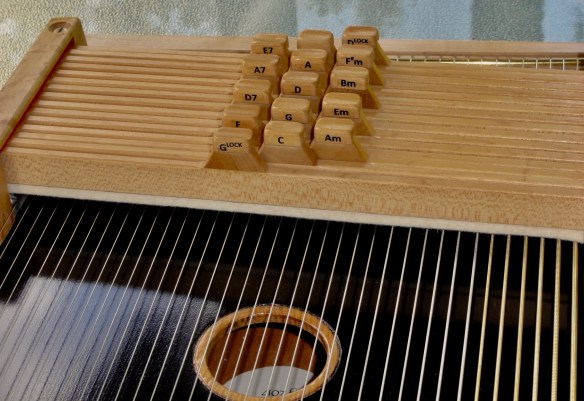
The instrument is set up as a thirty-seven string diatonic in the keys of G and D. The fifteen chord bars are arranged in three rows with the major chords in the middle, the sevenths on the top, and the minors in the bottom row. The two chord bars nearest the tail end are lock bars. One is a D lockbar that mutes the strings in the array that aren’t in the key of D (four C strings and one F). The G lockbar mutes the strings in the array not in the key of G ( two C# strings and one F). By muting the unnecessary notes the player is less likely to play them by mistake.

Chord array before cutting the felt and installing the locks.
One might wonder why there is an F note on a G/D autoharp. By changing one string in an F# pair to F and cutting an F chord bar, this autoharp can also play the IV chord needed in the key of C.
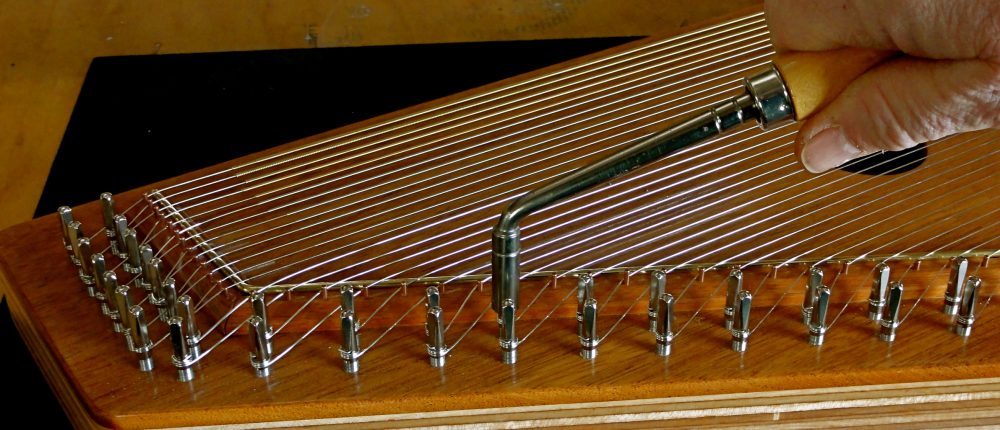
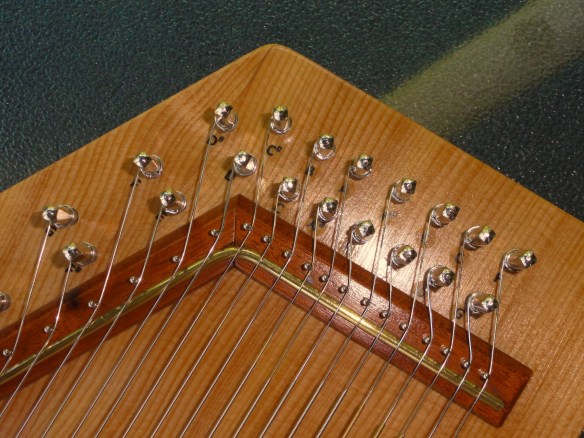
 The thirty-seven strings are anchored at the tail end with a set of Daigle Flatline fine tuners. Each string can be fine tuned by turning its allen screw with a small wrench. This is especially useful with a diatonic autoharp that has several string pairs that need to be tuned in unison and beatless. Fine tuners are also helpful for tweaking the strings that go a little sharp or flat from day to day environmental changes in temperature and humidity.
A wood handled allen wrench was supplied with the tuning assembly but I made an additional, smaller one that seats magnetically in a hole at the end of the tailpiece. It’s handy, right there near the tuners and not lost amid all of the other paraphernalia that travels with the instrument.
The new owner performs at a variety of venues, open mics, and with a regular bluegrass jam. He uses a sound system when he performs and plays his instruments unamplified with the bluegrass. The Dove can be amplified via a Schreiber electromagnetic pickup that is invisibly installed on the soundboard underneath the chord bars. It is wired to a 1/4″ jack that is imbedded flush on curved treble bout. 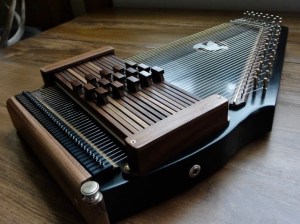
 “Ah, but I was so much older then
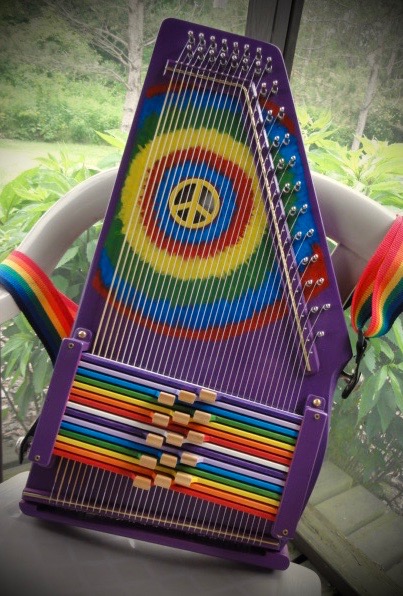 Our lives have changed a lot since then but there is still that old friend nostalgia. For me, it surfaces from time to time in the form of a rather whimsical creation like… this “Hippy ‘Harp”.
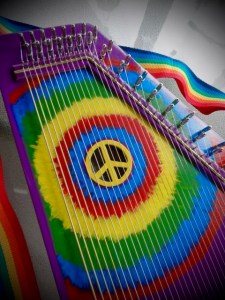
 Apart from the paint job, it differs little from my standard instrument. It’s a thirty-six string chromatic with fifteen thin chord bars painted in a rainbow pattern ( it might be said that all of the chords are “color chords”). The quiet chord bars are carried on #6 steel bridge pins driven into Delrin bases. Structurely, it features a laminated pin block frame, birch ply back, and a solid poplar soundboard. A peace symbol rosette is inlaid in the sound hole and an there is an additional sound hole in the back that makes the sound more audible to the player’s left ear and is useful for handling the instrument.

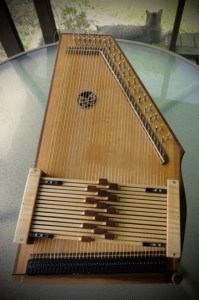
 The latest autoharp to emerge from my workshop is this thirty-seven string diatonic beauty ordered only two months ago by an autoharp friend named Lori. She currently plays chromatic autoharps and was amazed at the richer tone and greater volume of a two key diatonic. She often plays in the key of D with a dulcimer group but also finds the keys of G, C, and A useful. This diatonic is primarily set up for the keys of D and G but with the addition of a single F string can play the F chord needed for the key of C. The key of A is also present with the chords A, D, and a partial E7.
 Two of the fifteen chord bars are lockbars. They are fitted with small sliding Delrin locks on each end that slide under the chord bar holder caps. There is a G lockbar and a D lockbar. When locked down the bar mutes those notes not used in that key so they cannot be played accidentally.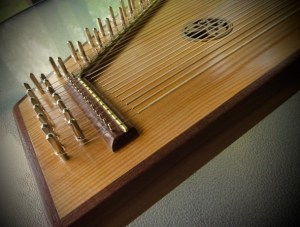


 I have recently completed a new left handed autoharp that I began last Fall. It was not a commission but built for general sale. It is a basic “A” style but differs from my previous builds as it features eighteen thinner chord bars carried on aluminium and steel combs instead of the traditional slotted chord bar holders. This makes for more chords, improved action, and less noise. I hope to include this feature on most of my future builds.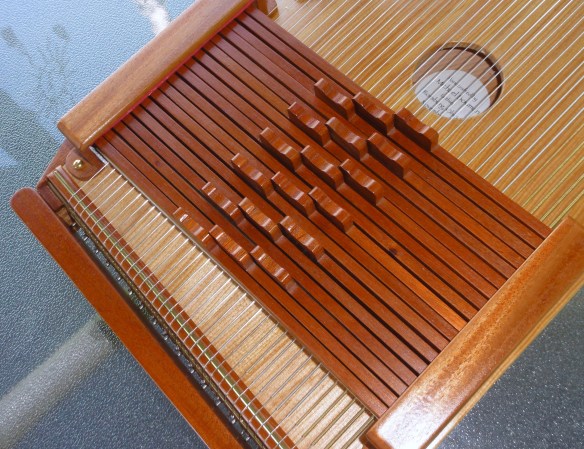
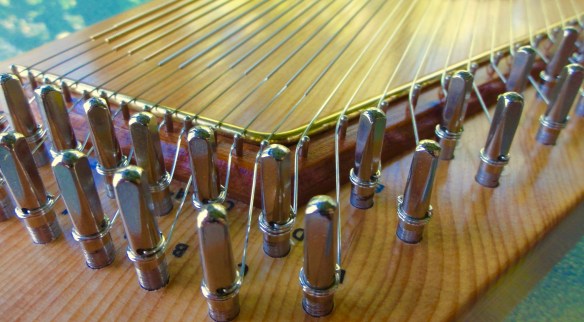 As a left handed autoharp, it is ideal for the left handed player wanting to play in an upright position or for playing on the lap by a right handed player ( read about left handed autoharps in the page on this site’s header).
 Features

 Fret Or Fret Not
You must be logged in to post a comment.