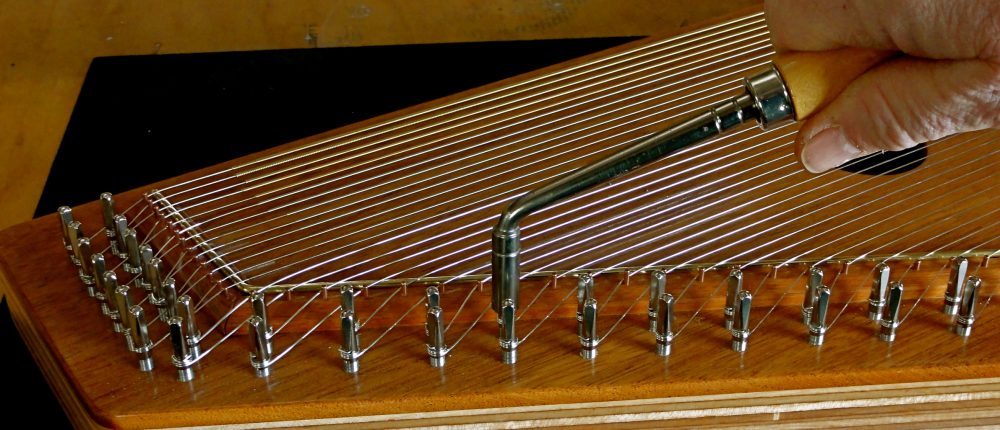
The following is my article that was published in the 2019 summer edition of the Autoharp Quarterly magazine.
 I have always maintained my own instruments, mostly out of economic necessity but especially for the challenging DIY learning experience. This has led to a deeper understanding of what my instruments are capable of and how I might modify them to meet my personal needs. That has led to my forty plus years as a luthier, building and repairing a variety of stringed instruments.
My wife, Marsha, and I have always enjoyed autoharp music and began our own journey, as many do, by purchasing old autoharps on internet auctions. These needy ‘harps taught us tuning, restringing, and re-felting, but just as importantly, revealed design and aesthetic improvements that could benefit our musical experience. The next step (leap) in our journey was the decision to build our own using the many ideas we had gleaned from playing, observing, and “tinkering” with these wonderful instruments.
Have you reached this point in your journey? Building a box with strings on it is not as daunting as it may seem. If you possess the motivation, a little understanding of autoharps, some basic tools, and modest woodworking skills (or know someone who does) you too can build an autoharp to be proud of. Here are some ideas and resources to help you, the first time builder, get started.
Planning
Reverse engineering, or planning backwards, begins with ‘harps you can play or observe to determine the features you like. Take photos and accurate measurements. If you have access to a failed, unsalvageable ‘harp, trace a pattern and disassemble it to discover its acoustic and structural secrets or shortcomings.
Plans can offer specific direction or become a useful “jumping off point” for your own design. Included instructions illustrate the woodworking and assembly procedures involved.
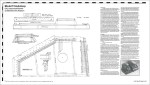 Plans for the Schmidt Model 73 are available for purchase from the Guild Of American Luthiers.
 Musicmakers offers a free download of plans and assembly instructions for their long discontinued “Autochord” kit and continues to sell the collated hardware to complete it. The Autochord differs somewhat in size and construction from other ‘harps but offers many helpful ideas. The file can be enlarged to full size at a retail copy center.
 The Autoharp Owner’s Manual includes excellent plans and instructions for building “The Mountain Laurel Autoharp”, along with a wealth of maintenance and setup information. The design can support more chord bars, diatonic stringing schedules and aesthetic details. The plans can be photocopied and enlarged to full size at a retail copy center.
Materials
- Hardware stores stock the more common items such as screws, brass rod, glue, and finishing supplies.
- Specialized hardware such as zither and bridge pins can be purchased from online vendors or a piano supply company.
- Chord bar felt, OS parts, fine tuner assemblies, pickups, pins, springs, etc., can be purchased from many autoharp luthiers and Elderly Instruments.
- Standard and custom string sets are made by Greg Schreiber.
Wood
- Wood can be sourced from lumber yards, sawmills, local woodworkers, and online. If you cannot plane and sand solid woods for the thinner back and soundboard, consider the 1/4” marine and cabinet grade plywood sold in big box stores such as Lowe’s. They also stock 1/4” x 6” solid poplar that can be joined to produce a better soundboard than plywood. With some patience and careful sorting, you can often find attractive quarter sawn stock.
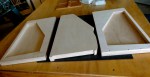 The best framing material for tuning and overall stability is the multi-laminated maple pin block manufactured for pianos. It grips tuning pins without cracking and remains stable in changing environmental conditions. It is particularly effective when cut as a single unit for the angled treble side, as it eliminates a troublesome joint that wants to creep. I like to cut the entire frame from a single blank so that there are no joints to fail. Pin block can be obtained from a piano technician or piano supply but the planks are fifty-nine inches long, so it’s unlikely that they would sell only enough for one ‘harp. Contact me to purchase a more economical size.
In closing
When you create your own special box with strings, not only do you increase your knowledge and skills of everything autoharp, but also you get a warm fuzzy rush every time someone asks, “Who made your autoharp?”
Links
Plans
The Guild Of American Luthiers: http://www.luth.org
Musicmakers : https://www.harpkit.com
The Autoharp Owner’s Manual compiled and edited by Mary Lou Orthey is available from Daigle Autoharps: http://www.daigleharp.com
Materials
Schaff Piano Supply (wholesale) https://www.schaffpiano.com
Vanda King (retail piano supply): https://www.vandaking.com
Elderly Instruments: https://www.elderly.com
Greg Schreiber: http://schreiberautoharps.com
Michael Bowman: https://fretorfretnot.com
 Several years ago they produced their version of an autoharp and called it an “Autochord”. It was a unique design that differed from the more conventional Chromaharps and Oscar Schmidts. Thirty-eight ball end guitar strings spanned from bridge pins to an anchor end bridge made from a section of brass tubing. The chromatic tuning was scheduled from F2 to A5. The fifteen chord bars rested upon 1/8 Delrin rods drilled directly into the soundboard. The body of the instrument consisted of a 1/4″ redwood soundboard with a bass bar, a 3/8″ plywood back, and a laminated frame with gaps at each end of the long rail.
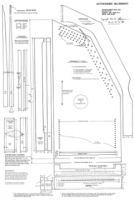 This interesting instrument was offered as an easy to assemble kit for someone with basic DIY skills. Like all of Musicmakers kits, it would, with attention to detail, bring satisfying results. The result however, was a rather large, heavy, and somewhat unconventional autoharp.
 This Autochord kit came to my workshop in the original shipping carton. It was purchased in 1995 and had only the soundboard and back glued to the frame. The current owner asked me to complete it and install fine tuners.
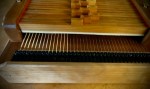 I made several modifications to the original design. The Daigle fine tuner system came with its own bridge so I deleted the kit’s brass tube. The wound bass strings supplied were standard guitar strings that had windings their entire length. Greg Schreiber made a custom set of wound strings that had windings only within the speaking length of the strings. I substituted threaded adjustable bridge pins so I could accurately level the strings for effective damping.
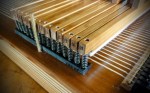 The design specified drilling the Delrin chord bar combs directly into the soundboard. Instead, I made separate Delrin bases that can be more easily adjusted for smoother chord bar movement.
 Fret Or Fret Not
You must be logged in to post a comment.