Some time ago, June 8th, 2018 to be precise, I posted here about one of my first “art ‘harps.” That autoharp creation was much like my usual custom instruments but (pun alert) highly decorated with a whimsical, tie-dyed, peace, and counter culture theme. It was quickly scooped up and shipped to a faraway continent where I hope that it is still singing amid the billabongs and coolabah trees.
Moving ahead to 2025, that first Hippy ‘Harp attracted the attention of a musician from New York who performs with autoharp and teaches music and theatre to children. She asked if I could recreate a version of that instrument.
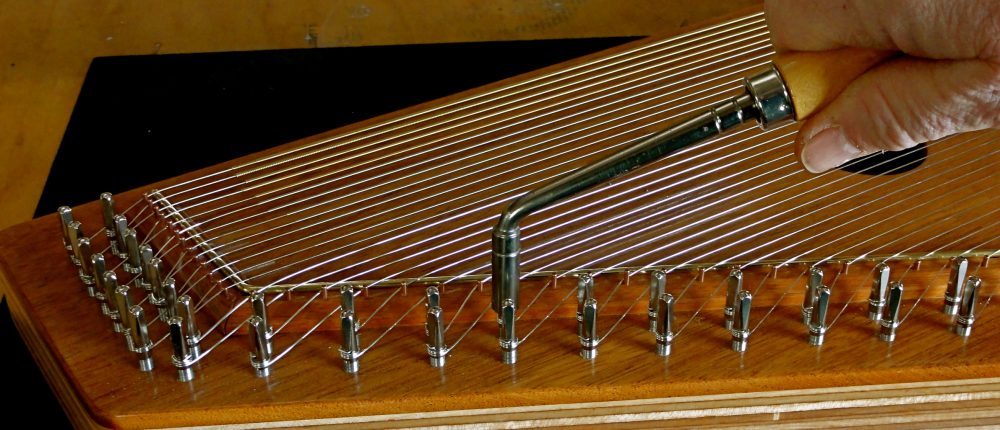
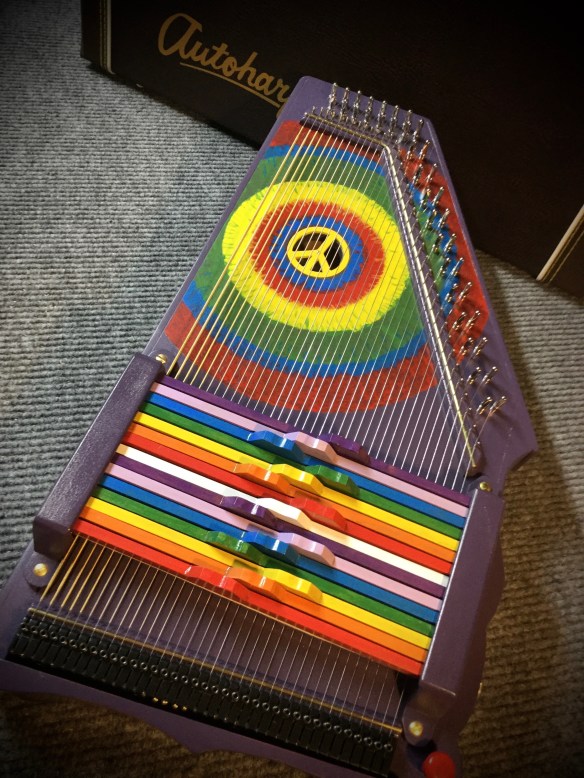 The appearance of the new Hippy ‘Harp is much the same as the original with a peace symbol rosette, tie-dyed paint job, and rainbow colored chord bars. This new version includes a solid cedar soundboard, Daigle fine tuners, and a Schreiber electromagnetic pickup.
What really sets this autoharp apart is the chord bar setup. I had begun building this instrument as a fifteen chord chromatic with the standard setup of major, minor, and seventh chords. At some point in the process I asked the musician if she might be interested in a chord system that I was just learning about, the PRIZIM.
The PRIZIM system was developed by Pennsylvanian autoharpist Loren Todd Crowley et al. With this intriguing design, a greater number of chords can be played by pressing two chord bars at a time. Hippy ‘Harp with standard chromatic tuning and fifteen conventional chord bars is mechanically the same as my other autoharps. The exception that makes this a PRIZIM is the patterns of open note cuts in each of the chord bar felts.
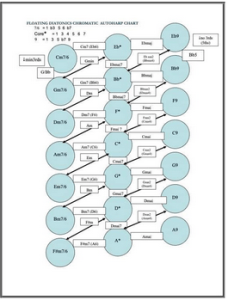
Online PRIZIM chart for 21 chord chromatic autoharp
The PRIZIM system can be adapted to almost any autoharp. Chord charts and cut patterns for twenty-one chord autoharps are available online. Because I was in the middle of building a fifteen chord instrument, I consulted with Loren for advice in using fewer bars. The result was a full compliment of two button chords in the keys of C, G, and D and dozens of combinations.
On paper, the PRIZIM’s unusual (to me) chord names and layout was confusing but once the instrument was set up, I could understand the logical layout and how easy it is to play. Chord names like stars, 6/7s, 9s, and add2s do not appear on any manufactured chord labels. For initial orientation I labeled the bars with basic chord names and provided the musician with a hand drafted chart. The experienced player should quickly grasp the logic of the system and will no longer need rely upon the labels.

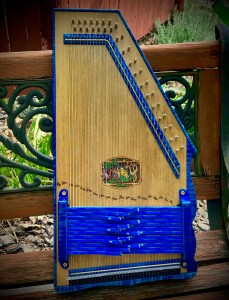 As a landlocked luthier here in Ohio, I truly miss the ocean. Marsha and I have lived in a coastal town on the Great Barrier Reef. We have wandered beaches in Florida, Cape Cod, Oregon, Nova Scotia, Iceland, and Ireland. We even spent two months at sea working on a container ship that crossed both Tropics and the Equator. With only some photos and a smattering of shells to sustain our fading memories, I sometimes regret leaving those experiences behind for life in the flatlands.
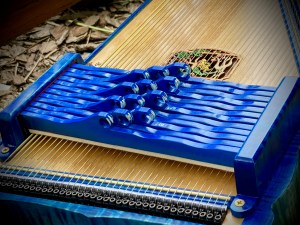 This thirty-seven string instrument has twelve chord bars shaped like waves. The three rows of buttons resemble white caps. Bridges, chord bar holders, tail cover, and side trim are made of curly maple dyed bright blue to show an iridescent, wave like grain.
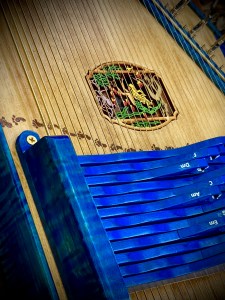
 A laser cut rosette adorns the sound hole and bare footprints cross the sandy colored solid spruce soundboard.
 The laminated back has been painted bright blue using netting as a stencil. Captured in this fish net is a colorful jellyfish soundhole.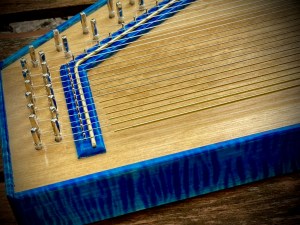
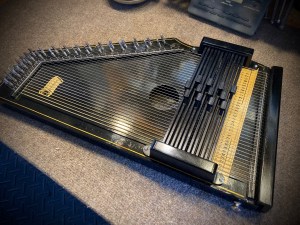 Recently, a musician from Louisiana sent me an “Old Black Box”, or rather, a thirty-six string, twelve chord Oscar Schmidt autoharp that was manufactured in 1958. As with many of these older “A” models purchased on-line, from families, or from estate sales, it was covered with dust and gunk. Still, it had possibilities so the owner had it polished and restrung with Schreiber “Old Model A” strings. It was sent to me in excellent condition for a couple of useful upgrades.
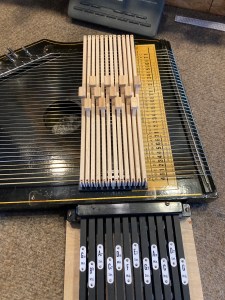 The owner learned to play the old way, below the chord bars. He also wanted to be able to play above the bars in the high treble area. To accomplish this I made chord bars 3/16 inches wide which made the chord set narrower. By repositioning the set in the center, there was now 1-1/2 inches above and 1-1/2 inches below the chord bars allowing play both ways.
 I tried to retain the aged/historical appearance by coloring the new chord bars and holders black and installing a used tuning pin to match the old ones.
 I realize that the title of this post is kind of a stretch but it’s embarrassingly indicative of how my mind sometimes works. “My Name Is Morgan But It Ain’t J.P.” is an old time song that was covered by The New Lost City Ramblers. Mike Seeger, a member of the trio, famously owned and played an autoharp (not on that song) built by Tom Morgan of Morgan Springs, Tennessee. It was in admiration of Mike Seeger’s Morgan autoharp that prompted an Ohio musician to obtain the one I’m about to describe.
 Long story short…. this beautiful instrument arrived in 1980 fully finished but absent the chord bars. For various reasons Mr. Morgan could not complete the chord set but instead sent along sufficient rough stock of Brazilian rosewood for their fabrication. The instrument has slumbered peacefully and unplayed for over forty years until it came to my workshop last October.
 There are several features that make this a very distinctive autoharp. The woods, spruce and Brazilian rosewood, were purchased by Mr. Morgan at auction from the C.F. Martin guitar company where they had been in storage since the 1940s. The one piece spruce soundboard carries two of Morgan’s trademark “f” holes and is carved into a gentle violin- like arch. Although I couldn’t observe them because of the size and location of the sound holes, there apparently exist an internal pre-stressed truss rod and tone bars that, with a stainless steel anchor end reinforcing plate, make this a very stable instrument.
 Although unplayed, the chromatic string set was forty years old and a little corroded. After much consideration it was decided to replace it with a scale designed for diatonic play in the keys of G and D. An optional F note replaces an F# in the scale to allow an F chord for play in the key of C. The chords were chosen based upon the songs that will be accompanied and extra stock was made into additional minor chords, two lock bars, and blank bars for future need.
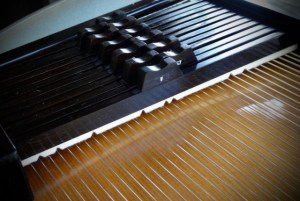 The twelve, 5/16 inch-wide chord bars are arranged in two rows as was probably the intention of the builder. They rest upon #6 steel pins driven into Delrin bases. The Seeger autoharp bore round buttons that were sometimes broken. These chord bars were fitted with comfortable dished trapezoidal buttons made of rosewood.
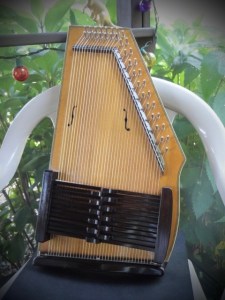 It was both an honor and a challenge completing this beautiful sounding instrument. Rosewood is a hard and oily wood that was not kind to tools and abrasives. I had some anxiety over making the most use of the limited and irreplaceable chord bar stock that was provided.
 Finally, after over forty years of initial correspondence with the instrument’s luthier Tom Morgan, weeks of consultation in my workshop, and even a global pandemic, the patient musician and his Morgan autoharp #80002 sing together.
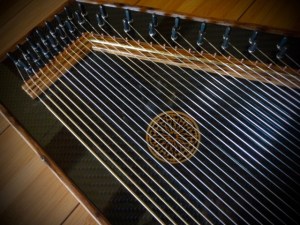 With few exceptions, autoharps have been made of wood. Solid and laminated hardwood frames have been enclosed by hardwood, softwood, and plywood with the builder’s and player’s personal preferences guiding the combination. Decades of research and experimentation with natural materials have led to construction techniques for building good sounding and structurally stable instruments but swings in temperature and humidity persist in causing cracks, bulges, separations, tuning instability and even implosions. Temperature control, humidifiers in the winter, dehumidifiers in the summer, and fine tuners all help us avoid adverse environmental effects but, as careful as we are, there can be some disappointing surprises. Could there be a material that’s very stable and sounds good? Carbon fiber may be the answer.
 Carbon fiber, a very strong and rigid composite material, has been used successfully to build musical instruments for many years. The first luthier to utilize this material in sheet form for autoharp construction was Pete Daigle of Daigle Autoharps in Seattle, Washington.
 My recent interest in trying carbon fiber has taken the form of this new thirty-seven string chromatic. With my one piece laminated frame and back and a carbon fiber soundboard, I’m hoping that this buggy will never crash and the only maintenance necessary will be the occasional tune-up and maybe a couple of future brake jobs.
 I ordered a 12″x24″x1/8″ blank sheet of carbon fiber from the DragonPlate company in Elbridge, NY. The purchase cost and machining labor was about five times greater than that of making a comparable wooden top.
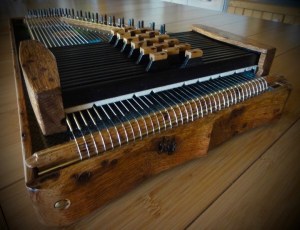
  The 1/4″ side veneer, tailpiece, and chord bar holders are made of red oak with an interesting “bark intrusion”. The eighteen maple chord bars are lacquered black and the buttons have been randomly burnt with a mini torch to resemble the oak trim.
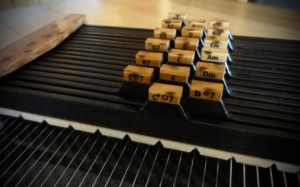 The standard chromatic tuning schedule includes a thirty-seventh string tuned to D6. The eighteen thin chord bars are carried by steel pins driven into Delrin bases. The three row setup favors the keys of C, G, and D and includes the Cdim7th, C#dim7th, and Ddim7th chords.
 To access the chord bars for adjustment or change I made magnetic holder covers that can be easily popped open without removing screws. The caps are aligned with tiny pins at each end and held fast in the center by small rare earth magnets. Self adhesive felt strips on the underside of the caps quietly adjust the chord bars’ height for a low playing action.
 So, how does this carbon fiber sound? For us, it is too soon to say anything other than “different”. Folks who play the Daigle carbon fiber harps report that they are loud, bright, and have a “crazy amount of sustain”. It does seem louder than our other instruments but we need a “breaking in” period before we can assess its tone, articulation, and presence. Almost as important is the expectation of greater structural stability and the attractive visual combination of carbon fiber and red oak.
 Fret Or Fret Not
You must be logged in to post a comment.