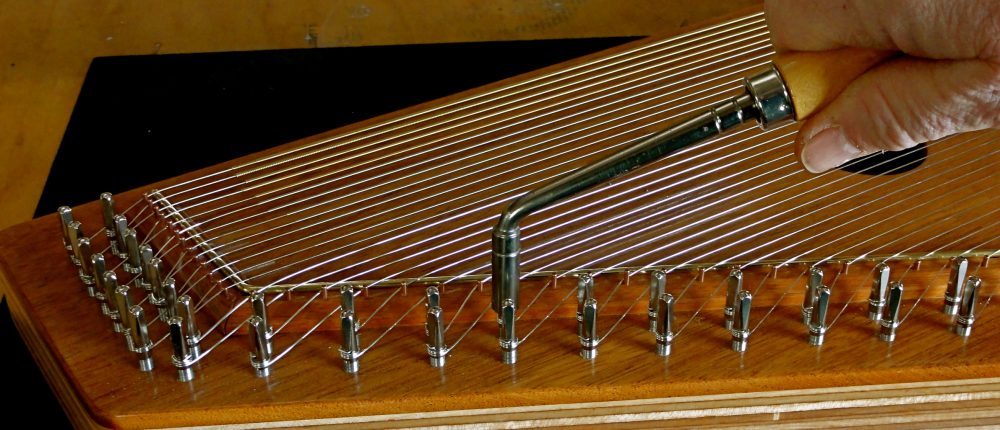
 I have recently completed three of my 3/4-size autoharps that are for sale and will soon be ready for delivery.
About two years ago I began building these smaller sized autoharps aimed at younger learners beginning their autoharp journey. I saw a need for a serious alternative to the painted “toys” produced by manufacturers in the past. With twenty-three strings and seven chords, my Child ‘Harps are lighter and easier to tune and play than their larger siblings.
They measure eighteen inches long, ten inches wide, and weigh under five pounds. Due to their smaller size and handmade quality, Child ‘Harps have also become attractive to adults who find them less stressful and fatiguing than playing larger, heavier autoharps. Having standard string and chord button spacing, they are ideal for the adult player adapting to a smaller instrument or the young learner who will eventually grow into a big autoharp.
 The design and construction is fundamentally the same as my full sized instruments. For structural integrity and tuning stability I build with one- piece laminated frames, and solid wood soundboards and components. They have a rich full voice for their size and are built to last.
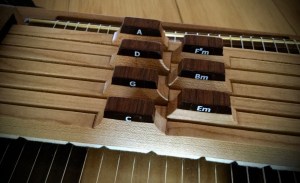
Chords in the keys of G and D.
Child ‘Harps come in two different two-key diatonic setups, each with seven chords. Being diatonic means that the string array doesn’t include all the notes in the chromatic scale but only the notes needed in the two keys. The G/D ‘harp plays in the keys of G and D and has four major chords (C, G, D, and A) and three minor chords (Em, Bm, and F#m). The F/C ‘harp plays in the keys of F and C and has four major chords (Bb, F, C, and G) and three minor chords (Dm, Am, and Em). The scale is similar to the mid and treble range found in standard autoharp tuning with the lowest note in the 3rd octave and the highest in the 6th octave. Unlike standard diatonic autoharps, these do not have doubled string courses.

Chords in the keys of F and C.

SOLD SOLD SOLD Child ‘Harp with walnut trim and solid poplar soundboard. Complete and ready for stringing and setup in buyer’s choice of either keys of F/C or G/D.
I try to make each of my instruments unique in some way so these three new ones are built using different wood combinations and tuning setups. Each is for sale and include a quilted “cozy” and a star tipped T-wrench for tuning.
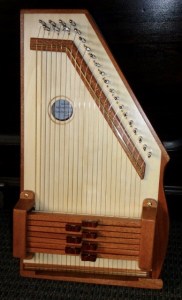
Twenty-three string, seven chord diatonic plays in the keys of F and C. African mahogany trim with an aspen soundboard.
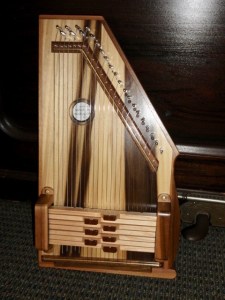
Twenty-three string, seven chord diatonic plays in the keys of G and D. Walnut trim with poplar soundboard
 Since introducing my new twenty-three string, seven chord child size autoharps two months ago, I received a lot of interest and positive comments. My goal was to produce a serious instrument for the young learner to play while growing into a standard, full size autoharp. I guess I wasn’t too surprised when several adults found them to be a good size as a travel instrument or for someone challenged by the size and weight of a more standard autoharp. At only eighteen inches long and weighing only four and one-half pounds, they are easy to hold and carry.
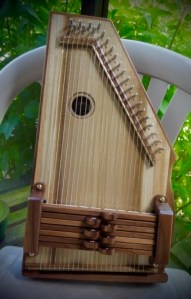

 With that in mind, I present my own iteration of a child size autoharp designed as a serious, good sounding, and well built instrument for the young learner. I believe that a quality, attractive, and stable instrument with standard string spacing, and a logical chord bar setup will make it easier to learn and to later grow into a standard autoharp. My aim is to produce a smaller scale instrument for fun as well as serious study and not a colorful toy of passing interest.

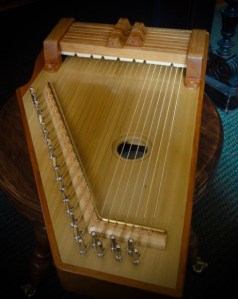 The high quality Schreiber custom string set is specially gauged for a string schedule tuned: G-C-F-G-A-B-C-D-E-F-G-A-A#-B-C-D-E-F-G-A-A#-B-C.
 At this time the only option I can offer is the choice of woods for the side veneer, chord set, bridges, and end cover. This prototype is cherry but other choices include walnut, maple, and mahogany. In the future I plan to add greater customization and alternate chord setups with more chords in two or three rows.
 Fret Or Fret Not
You must be logged in to post a comment.