Some time ago, June 8th, 2018 to be precise, I posted here about one of my first “art ‘harps.” That autoharp creation was much like my usual custom instruments but (pun alert) highly decorated with a whimsical, tie-dyed, peace, and counter culture theme. It was quickly scooped up and shipped to a faraway continent where I hope that it is still singing amid the billabongs and coolabah trees.
Moving ahead to 2025, that first Hippy ‘Harp attracted the attention of a musician from New York who performs with autoharp and teaches music and theatre to children. She asked if I could recreate a version of that instrument.
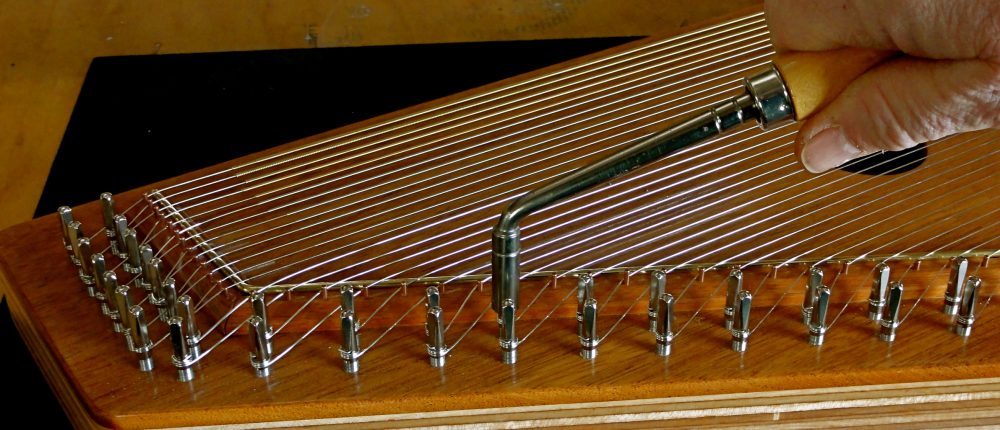
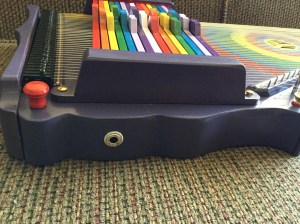
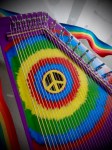
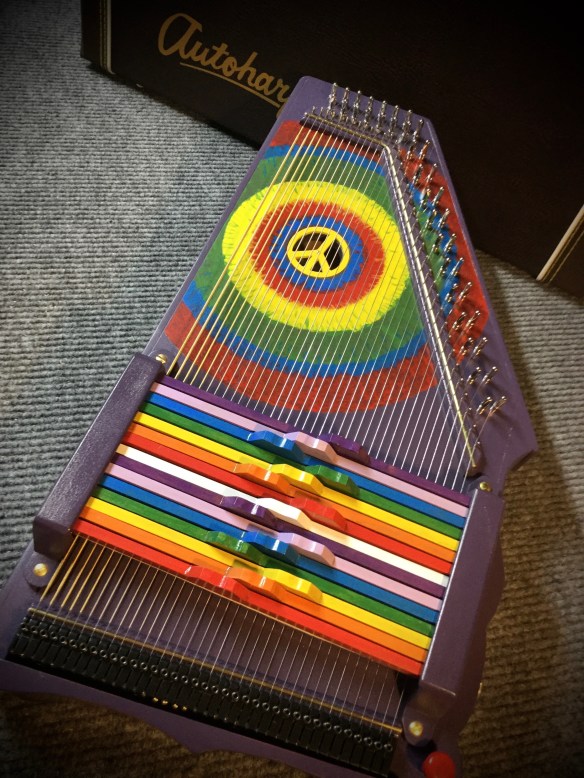 The appearance of the new Hippy ‘Harp is much the same as the original with a peace symbol rosette, tie-dyed paint job, and rainbow colored chord bars. This new version includes a solid cedar soundboard, Daigle fine tuners, and a Schreiber electromagnetic pickup.
What really sets this autoharp apart is the chord bar setup. I had begun building this instrument as a fifteen chord chromatic with the standard setup of major, minor, and seventh chords. At some point in the process I asked the musician if she might be interested in a chord system that I was just learning about, the PRIZIM.
The PRIZIM system was developed by Pennsylvanian autoharpist Loren Todd Crowley et al. With this intriguing design, a greater number of chords can be played by pressing two chord bars at a time. Hippy ‘Harp with standard chromatic tuning and fifteen conventional chord bars is mechanically the same as my other autoharps. The exception that makes this a PRIZIM is the patterns of open note cuts in each of the chord bar felts.
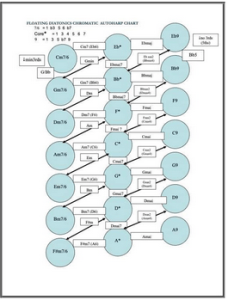
Online PRIZIM chart for 21 chord chromatic autoharp
The PRIZIM system can be adapted to almost any autoharp. Chord charts and cut patterns for twenty-one chord autoharps are available online. Because I was in the middle of building a fifteen chord instrument, I consulted with Loren for advice in using fewer bars. The result was a full compliment of two button chords in the keys of C, G, and D and dozens of combinations.
On paper, the PRIZIM’s unusual (to me) chord names and layout was confusing but once the instrument was set up, I could understand the logical layout and how easy it is to play. Chord names like stars, 6/7s, 9s, and add2s do not appear on any manufactured chord labels. For initial orientation I labeled the bars with basic chord names and provided the musician with a hand drafted chart. The experienced player should quickly grasp the logic of the system and will no longer need rely upon the labels.

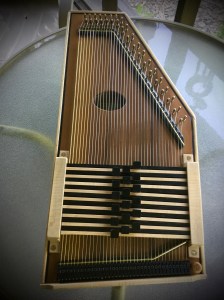 My latest commission comes from an autoharp musician/aficionado from New York State requesting a much deeper instrument with more resonance and a richer tone. Early planning was for a three inch depth but we finally settled on a depth of 2-1/2 inches to make an instrument you could really wrap your arms around. The working title became “ED”, standing for extra dimension.
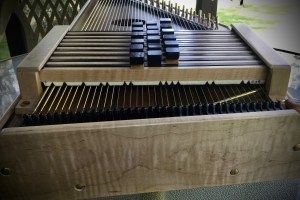 I began with my standard, one piece, pinblock frame which was extended in length to accommodate eighteen chords, an angled anchor bridge, and Daigle fine tuners. I added a 3/4 inch thick spruce spacer around the underside of the frame before attaching the soundboard, laminated back, and curly maple side veneer.
 Players with a shorter reach than this musician might find it difficult to play this deeper autoharp comfortably. To make the instrument narrower, I built it without the curved treble side that usually adds an inch of width. That, with lower chord bar covers, makes it easier to reach the buttons with the left hand.
 The solid cedar soundboard features an oval soundhole to round out the rich tone. The benefit of this deeper body with its larger internal capacity is greater volume and longer sustain.
 Having thirty-seven strings, this autoharp is set up in the single diatonic key of A. The eighteen chord bars are alternating natural maple and painted black. The musician wanted, of course, the chords in the key of A but also alternative chords that would have an ethereal feeling. For this he sought the advice of Jo Ann Smith who designs expert chord layouts and charts for cutting each individual chord. Ordinarily, a single key can be covered nicely with eight or ten chords. This instrument has fifteen chords with three additional blank bars to be cut when determined later.
 It’s been some time since I weighed in on this kinda hybrid weblog/website. Weblogs beg frequent entries and websites contain information and the mechanics of the biz. I have been remiss in both. The daily statistics, when I check them, have been heartening and I truly appreciate the many visits. I have kept up with the frequent requests for information and advice but haven’t had a lot of new content to post about my work.
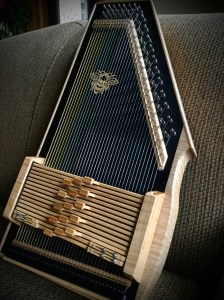 I built this F/C diatonic for a musician in New York state whose mother, by coincidence, resides here in Darke County. It was so nice that she traveled here to take delivery as it’s not often that I meet my clients face-to-face.
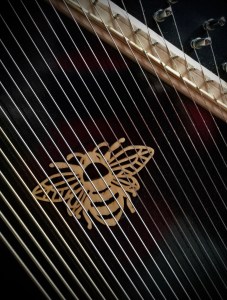 The musician’s name means “bee” so she requested and choose a bee as a soundboard rosette. As luck would have it, Etsy had a laser cut bee ornament of the appropriate size.
 Thirteen chords with two lock bars cover this two key arrangement. This “Bowers” setup has the majors in the center row, minors in the bottom row, and sevenths (+sus) in the top row.
 Daigle fine tuners with an onboard fine tuning wrench complete this very nice instrument.
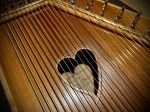
 Apertures (sound holes) in stringed musical instruments have been studied, experimented with, and designed for a variety of acoustic functions and characteristics. While a sound hole’s size, shape, and position certainly influence tone and volume, its appearance is what catches the eye and creates a kind of identity.



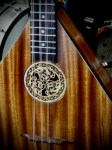
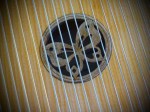
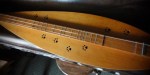


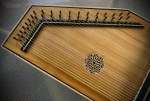
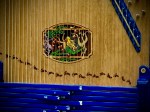
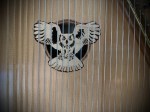

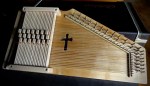



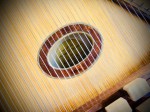
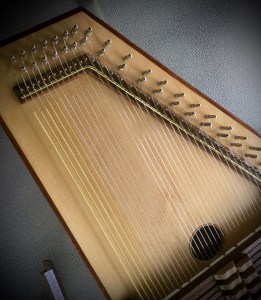 A musician from Tennessee recently commissioned this custom autoharp with several features that, to me, are very similar to the fifteen chord Oscar Schmidt and ChromaHarp models of the past. Over the years those A style chromatic models with their round sound holes, fifteen chord bars in two rows, and laminated soundboards underwent many improvements by their manufacturers. This musician seems to favor that style of instrument and was able to specify several construction, setup, and cosmetic improvements to suit his preferences and playing style.
 Most of my builds have been set up for playing in the area above the chord bars with the high treble strings unobstructed by the chord bar covers. This chord set is positioned closer to the tuning pins to permit play below the chord bars at the anchor end. Many of the old OS A models were arranged this way until playing the instrument upright became common and the bar set was moved south by their owners or the factories. This instrument is designed to be played on the musician’s lap with the left hand at the chords and the right hand playing near the anchor bridge.
 The old A models chord bars and buttons were 5/16 inches wide. I reduced these bars to a 1/4 inch width to narrow the array while leaving the buttons wide enough as to not require caps. The maple buttons are of a similar style to the older fifteen chord ‘harps and the chords are selected and arranged to the musician’s preference. He prefers a higher action (the height of the felt above the strings) for more vigorous chording. I set the travel high as requested but included extra self-sticking felt strips for under the covers should he choose to adjust the bars lower.
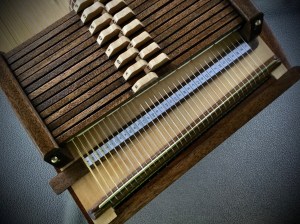 The modern improvements in the construction of this instrument include a solid spruce soundboard with tuned bracing, a one piece laminated frame, and quiet chord bars mounted on Delrin and steel pin combs. The chord bars, covers, side veneer, bridges, and tailpiece are made of African mahogany that has been stained dark brown. The musician requested that I not apply note labels under the tuning pins so I included a wooden tuning strip/duster that can be positioned under the strings to aid tuning.
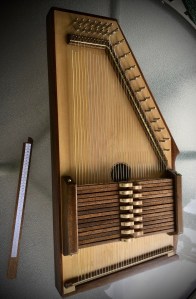 A custom built autoharp such as this can be built with the preferred features and options that improve playability and appearance. Sometimes it comes with a surprise: as the owner noted, “I was in shock at how light it is!”.
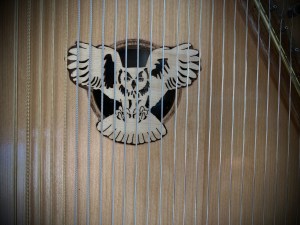 I have recently located a source of laser cut ornaments in a variety of subjects. Most are too large to inlay as a sound hole rosette but with many of them, I can trim away the bordering areas for a good fit.
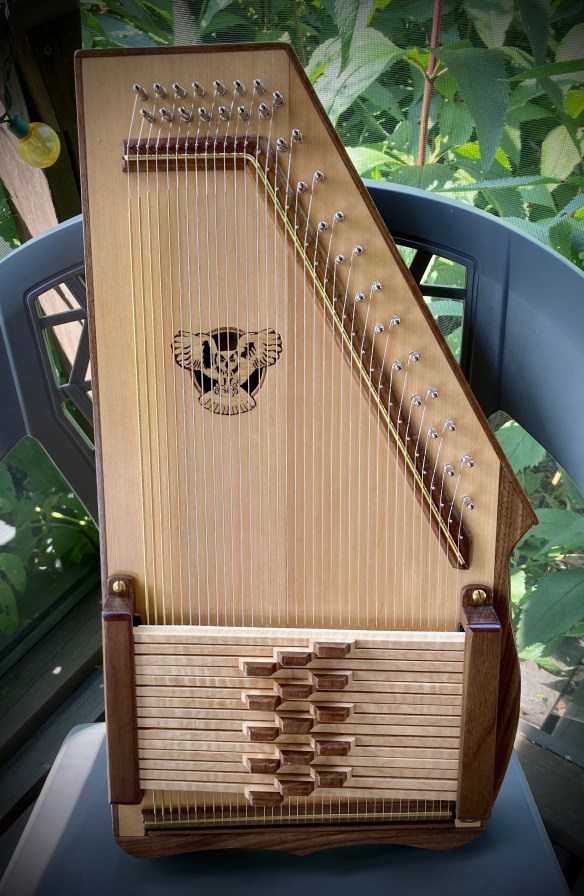 Here is a new custom thirty-six string chromatic autoharp. My standard, one piece pinblock frame features a spruce sound board, laminate back, and 3/16 inch thick walnut veneered sides. Matching walnut was also used for the brass rod-capped bridges, tail piece, chord bar covers, bridges and chord bar covers.
 The fifteen chord bars are made of curly maple. The contrasting buttons are capped with walnut.
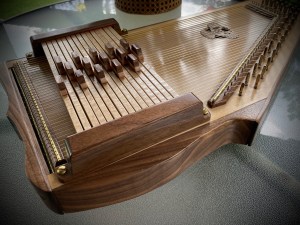

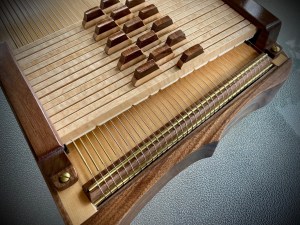
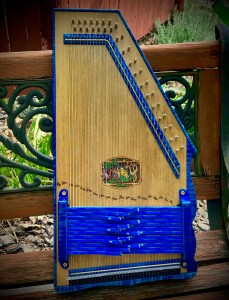 As a landlocked luthier here in Ohio, I truly miss the ocean. Marsha and I have lived in a coastal town on the Great Barrier Reef. We have wandered beaches in Florida, Cape Cod, Oregon, Nova Scotia, Iceland, and Ireland. We even spent two months at sea working on a container ship that crossed both Tropics and the Equator. With only some photos and a smattering of shells to sustain our fading memories, I sometimes regret leaving those experiences behind for life in the flatlands.
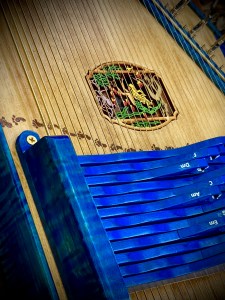
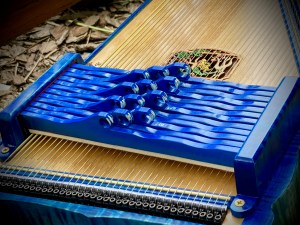 This thirty-seven string instrument has twelve chord bars shaped like waves. The three rows of buttons resemble white caps. Bridges, chord bar holders, tail cover, and side trim are made of curly maple dyed bright blue to show an iridescent, wave like grain.
 A laser cut rosette adorns the sound hole and bare footprints cross the sandy colored solid spruce soundboard.
 The laminated back has been painted bright blue using netting as a stencil. Captured in this fish net is a colorful jellyfish soundhole.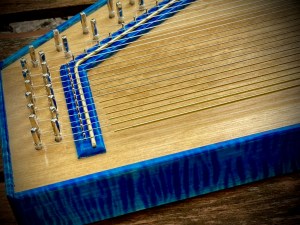
 Here is a new custom thirty-seven string chromatic autoharp that I built for a beginning autoharp musician here in Ohio. She plans to play worship and folk music to accompany herself and other vocalists. Because she resides within easy driving distance to Darke County, she and her husband could visit, view the many features and options available, and order the special instrument that is to be a birthday gift from her family.
 I always try to make each of my instruments unique so that my clients have a special instrument unlike any other. Of course there are constraints like scale, setup, and structure, but I like to give folks choices. This musician chose a western red cedar soundboard, maple chord bars, and curly cherry for the bridges, bar holders, buttons, and side trim.
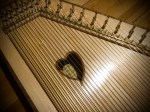
 A weeping heart was chosen for the sound hole. I made this by inlaying a 1/8″ thick cherry heart shape into the 1/4″ thick soundboard and then removing the inner heart shape leaving a 1/8″ wide cherry border.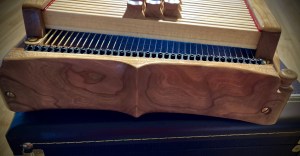
 The fifteen maple chord bars feature cherry buttons with the lateral dishing (rather than longitudinal dishing) preferred by the player. They move on #6 steel pins set into Delrin bases. The chord felt is yet uncut pending the player’s preferences.
 Structurally, this A style autoharp is built with a one piece laminated pinblock frame and a 1/4″ thick laminated birch back. Lately, I have been routing away unnecessary areas inside the frame to increase the interior volume. This, along with some tuned bracing, improves tone and volume.
 Hex screws are components of autoharp fine tuners. They are adjusted with some form of a hex key that is usually supplied with the assembly. This necessary implement is usually stored in the case, pick bag, or somewhere in that room you just walked into but forgot why.
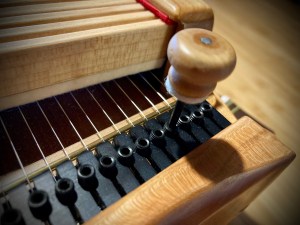 …………..where it’s right at hand for quick tuning touch ups.
 Many autoharps, especially manufactured ones, have decals, stickers, or note labels to designate the pitch of each string. These are unsightly and mostly unnecessary once the autoharp has attained a stable tuning. Some musicians convert their instruments to an alternative tuning such as a diatonic setup with a completely different tuning schedule that is no longer supported by the existing labels.
 I printed a tuning chart that I glued to a thin strip of wood. This can be slipped under the strings when needed as a reference for tuning each string.
 On the reverse side of the tuning strip is red felt. It prevents the wooden strip from scratching the soundboard and doubles as a convenient tool to remove dust under the strings.
 I recently completed is this thirty-seven string diatonic autoharp in the single key of A. I built it for ourselves because Marsha and I are trying to sing along with our instruments more and find that the key of A is a comfortable range for our voices. Being a single key diatonic, it has paired string courses in the middle octave and only the notes needed for chords in the key of A. This produces a very rich and full tone that works nicely for strumming accompaniment and playing melody.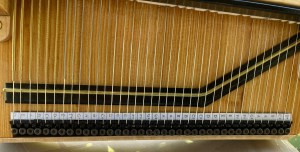
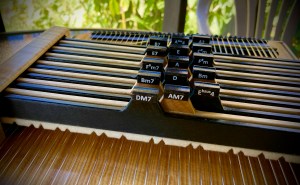 Fifteen chords are arranged in a “Bowers” type setup with major chords in the center row, sevenths in the top row, and minors in the bottom row. This familiar arrangement is in place on all of Marsha’s instruments and permits a sort of “motor memory” to kick in when she changes from one autoharp to another, even if in different keys. Seven of the chords are “color chords” for enhanced arrangements.
 The instrument has a 1/4 inch thick solid spruce soundboard. The one piece frame is laminated maple pinblock with a laminated maple back. The side veneer, end cover, and chord bar covers are made of curly maple. Chord bars are maple with alternate bars painted black. Black tuning pins, bridges, Schreiber fine tuners, and purfling complete the black/white motif.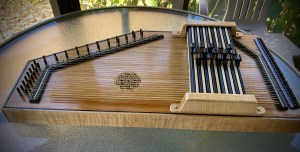
 Fret Or Fret Not
You must be logged in to post a comment.