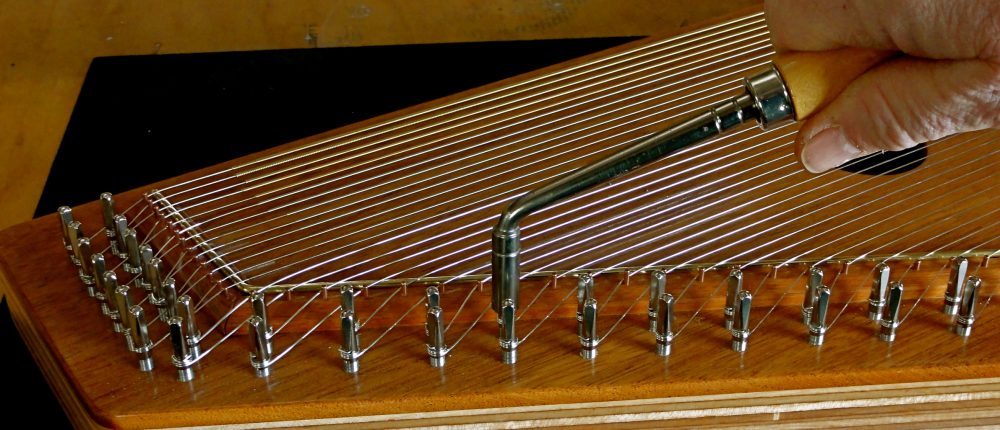
 I have recently completed three of my 3/4-size autoharps that are for sale and will soon be ready for delivery.
About two years ago I began building these smaller sized autoharps aimed at younger learners beginning their autoharp journey. I saw a need for a serious alternative to the painted “toys” produced by manufacturers in the past. With twenty-three strings and seven chords, my Child ‘Harps are lighter and easier to tune and play than their larger siblings.
They measure eighteen inches long, ten inches wide, and weigh under five pounds. Due to their smaller size and handmade quality, Child ‘Harps have also become attractive to adults who find them less stressful and fatiguing than playing larger, heavier autoharps. Having standard string and chord button spacing, they are ideal for the adult player adapting to a smaller instrument or the young learner who will eventually grow into a big autoharp.
 The design and construction is fundamentally the same as my full sized instruments. For structural integrity and tuning stability I build with one- piece laminated frames, and solid wood soundboards and components. They have a rich full voice for their size and are built to last.
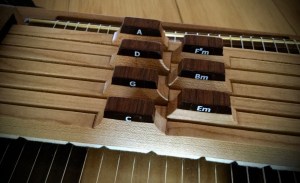
Chords in the keys of G and D.
Child ‘Harps come in two different two-key diatonic setups, each with seven chords. Being diatonic means that the string array doesn’t include all the notes in the chromatic scale but only the notes needed in the two keys. The G/D ‘harp plays in the keys of G and D and has four major chords (C, G, D, and A) and three minor chords (Em, Bm, and F#m). The F/C ‘harp plays in the keys of F and C and has four major chords (Bb, F, C, and G) and three minor chords (Dm, Am, and Em). The scale is similar to the mid and treble range found in standard autoharp tuning with the lowest note in the 3rd octave and the highest in the 6th octave. Unlike standard diatonic autoharps, these do not have doubled string courses.

Chords in the keys of F and C.

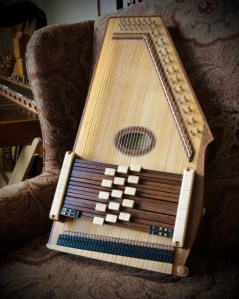
SOLD SOLD SOLD Child ‘Harp with walnut trim and solid poplar soundboard. Complete and ready for stringing and setup in buyer’s choice of either keys of F/C or G/D.
I try to make each of my instruments unique in some way so these three new ones are built using different wood combinations and tuning setups. Each is for sale and include a quilted “cozy” and a star tipped T-wrench for tuning.
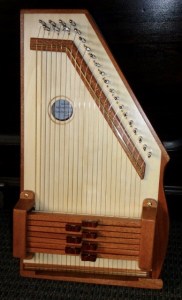
Twenty-three string, seven chord diatonic plays in the keys of F and C. African mahogany trim with an aspen soundboard.
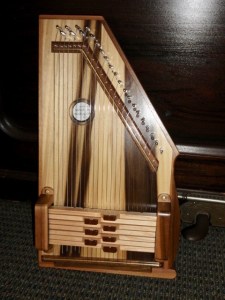
Twenty-three string, seven chord diatonic plays in the keys of G and D. Walnut trim with poplar soundboard
 I recently completed and delivered this commissioned instrument to a musician in New York state. After the initial contact and much discussion by e-mail, the entire process required only three months. The wait probably seemed longer to the musician anxious to receive his first luthier built autoharp but its completion was well within my usual two to five month time estimate.

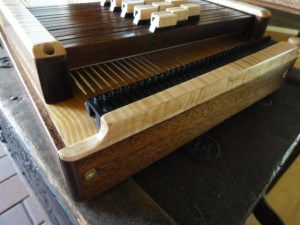 The chord bars, bridges, side veneer, chord bar covers, and tail cover are made of African mahogany stained with Minwax red mahogany oil stain. The chord bar covers, chord buttons, and tail cover are capped with curly maple finished natural. The soundboard is spruce, the back is maple veneer, and everything is finished with up to six coats of semi-gloss Deft lacquer.
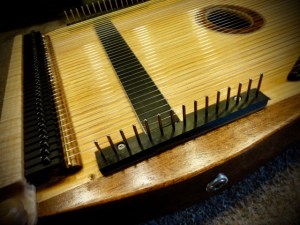 The Schreiber electromagnetic pickup is specially wound for this thirty-seven string array and is fastened underneath the chord bars by metal tabs that fit in slots on the underside of the Delrin chord bar combs. A small length of coax is routed through the inside of the instrument to a 1/4″ jack.
 Many of my autoharps are shipped out of state and abroad to musicians who will likely want to experiment with alternative chords or attend to future DIY adjustments and repairs. For this I include some extra blank felted chord bars, extra chord felt, self adhesive under cover felt, and extra springs. The wrapper from the custom string set will help them order the proper strings when it becomes necessary and a laminated strip indicates the tuning of each string. Also included is the allen wrench that comes with the fine tuners and a new star tipped T-wrench.
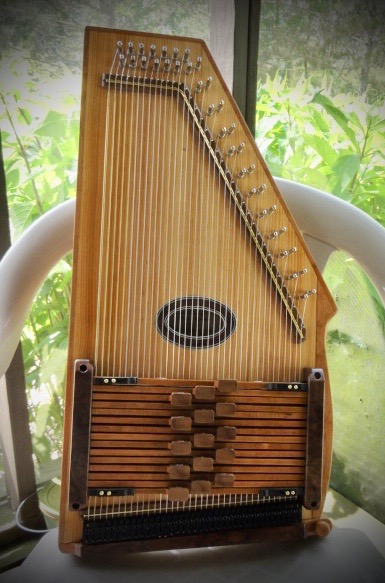 The latest from here at Fretnot Laboratories is this custom thirty-seven string, fifteen bar diatonic in the keys of G and D. It features Daigle fine tuners, two lock bars, flat chord bar buttons, and five extra blank chord bars for future substitutions. A custom oval rosette was fashioned using walnut burl and plastic white-black-white purfling. Walnut burl also trims the tops of the chord bar covers and the tail end cover.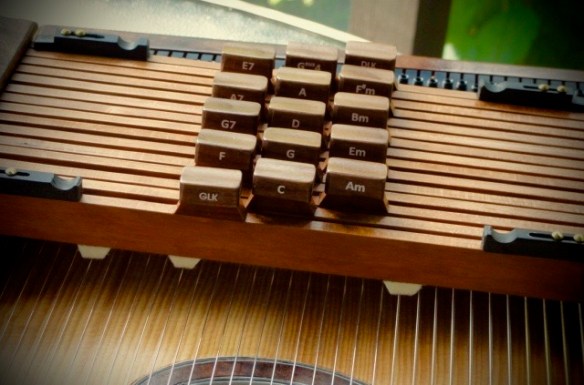
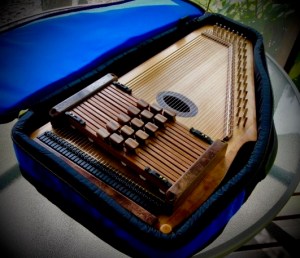
 Since introducing my new twenty-three string, seven chord child size autoharps two months ago, I received a lot of interest and positive comments. My goal was to produce a serious instrument for the young learner to play while growing into a standard, full size autoharp. I guess I wasn’t too surprised when several adults found them to be a good size as a travel instrument or for someone challenged by the size and weight of a more standard autoharp. At only eighteen inches long and weighing only four and one-half pounds, they are easy to hold and carry.
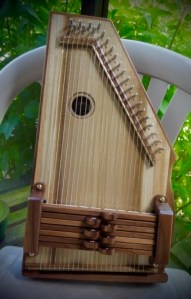

 With that in mind, I present my own iteration of a child size autoharp designed as a serious, good sounding, and well built instrument for the young learner. I believe that a quality, attractive, and stable instrument with standard string spacing, and a logical chord bar setup will make it easier to learn and to later grow into a standard autoharp. My aim is to produce a smaller scale instrument for fun as well as serious study and not a colorful toy of passing interest.

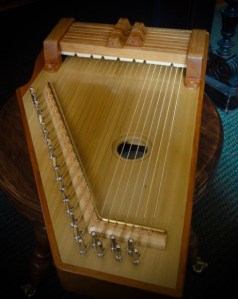 The high quality Schreiber custom string set is specially gauged for a string schedule tuned: G-C-F-G-A-B-C-D-E-F-G-A-A#-B-C-D-E-F-G-A-A#-B-C.
 At this time the only option I can offer is the choice of woods for the side veneer, chord set, bridges, and end cover. This prototype is cherry but other choices include walnut, maple, and mahogany. In the future I plan to add greater customization and alternate chord setups with more chords in two or three rows.
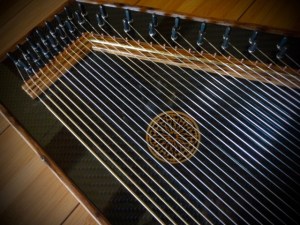 With few exceptions, autoharps have been made of wood. Solid and laminated hardwood frames have been enclosed by hardwood, softwood, and plywood with the builder’s and player’s personal preferences guiding the combination. Decades of research and experimentation with natural materials have led to construction techniques for building good sounding and structurally stable instruments but swings in temperature and humidity persist in causing cracks, bulges, separations, tuning instability and even implosions. Temperature control, humidifiers in the winter, dehumidifiers in the summer, and fine tuners all help us avoid adverse environmental effects but, as careful as we are, there can be some disappointing surprises. Could there be a material that’s very stable and sounds good? Carbon fiber may be the answer.
 Carbon fiber, a very strong and rigid composite material, has been used successfully to build musical instruments for many years. The first luthier to utilize this material in sheet form for autoharp construction was Pete Daigle of Daigle Autoharps in Seattle, Washington.
 My recent interest in trying carbon fiber has taken the form of this new thirty-seven string chromatic. With my one piece laminated frame and back and a carbon fiber soundboard, I’m hoping that this buggy will never crash and the only maintenance necessary will be the occasional tune-up and maybe a couple of future brake jobs.
 I ordered a 12″x24″x1/8″ blank sheet of carbon fiber from the DragonPlate company in Elbridge, NY. The purchase cost and machining labor was about five times greater than that of making a comparable wooden top.
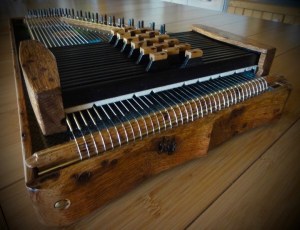
  The 1/4″ side veneer, tailpiece, and chord bar holders are made of red oak with an interesting “bark intrusion”. The eighteen maple chord bars are lacquered black and the buttons have been randomly burnt with a mini torch to resemble the oak trim.
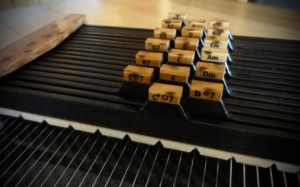 The standard chromatic tuning schedule includes a thirty-seventh string tuned to D6. The eighteen thin chord bars are carried by steel pins driven into Delrin bases. The three row setup favors the keys of C, G, and D and includes the Cdim7th, C#dim7th, and Ddim7th chords.
 To access the chord bars for adjustment or change I made magnetic holder covers that can be easily popped open without removing screws. The caps are aligned with tiny pins at each end and held fast in the center by small rare earth magnets. Self adhesive felt strips on the underside of the caps quietly adjust the chord bars’ height for a low playing action.
 So, how does this carbon fiber sound? For us, it is too soon to say anything other than “different”. Folks who play the Daigle carbon fiber harps report that they are loud, bright, and have a “crazy amount of sustain”. It does seem louder than our other instruments but we need a “breaking in” period before we can assess its tone, articulation, and presence. Almost as important is the expectation of greater structural stability and the attractive visual combination of carbon fiber and red oak.
 “Ah, but I was so much older then
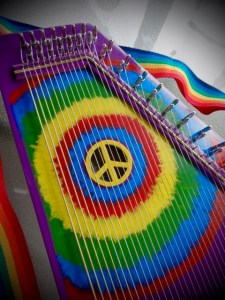
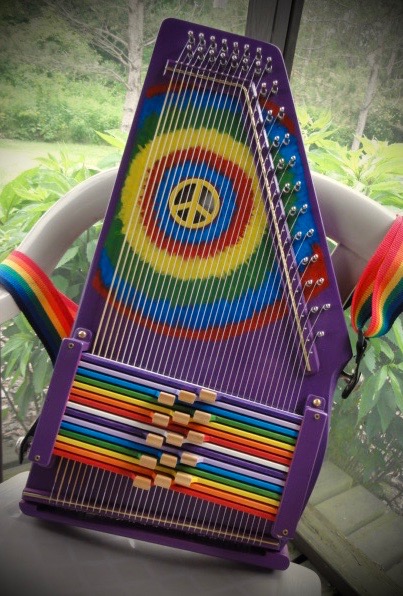 Our lives have changed a lot since then but there is still that old friend nostalgia. For me, it surfaces from time to time in the form of a rather whimsical creation like… this “Hippy ‘Harp”.
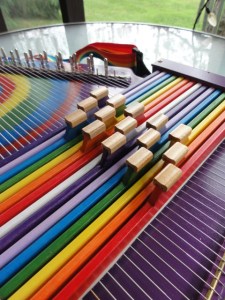 Apart from the paint job, it differs little from my standard instrument. It’s a thirty-six string chromatic with fifteen thin chord bars painted in a rainbow pattern ( it might be said that all of the chords are “color chords”). The quiet chord bars are carried on #6 steel bridge pins driven into Delrin bases. Structurely, it features a laminated pin block frame, birch ply back, and a solid poplar soundboard. A peace symbol rosette is inlaid in the sound hole and an there is an additional sound hole in the back that makes the sound more audible to the player’s left ear and is useful for handling the instrument.

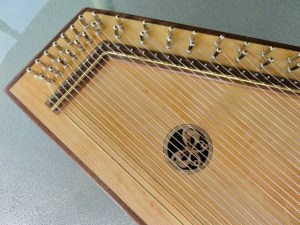 The latest autoharp to emerge from my workshop is this thirty-seven string diatonic beauty ordered only two months ago by an autoharp friend named Lori. She currently plays chromatic autoharps and was amazed at the richer tone and greater volume of a two key diatonic. She often plays in the key of D with a dulcimer group but also finds the keys of G, C, and A useful. This diatonic is primarily set up for the keys of D and G but with the addition of a single F string can play the F chord needed for the key of C. The key of A is also present with the chords A, D, and a partial E7.
 Two of the fifteen chord bars are lockbars. They are fitted with small sliding Delrin locks on each end that slide under the chord bar holder caps. There is a G lockbar and a D lockbar. When locked down the bar mutes those notes not used in that key so they cannot be played accidentally.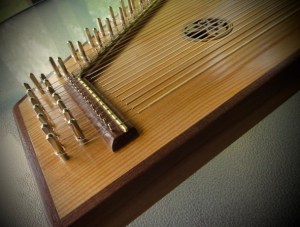


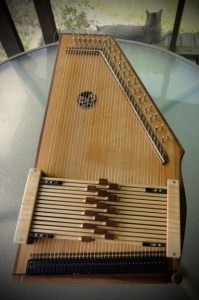
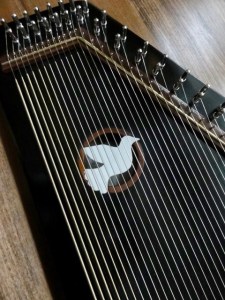 Here is a new custom autoharp commissioned by a musician and performer from Ontario. He desired a bright white “dove of peace” shaped sound hole on an all black body. The dove shape that he chose was too delicate to cut into the soundboard so I inlayed it in a walnut veneer ring with a bright white plastic material.
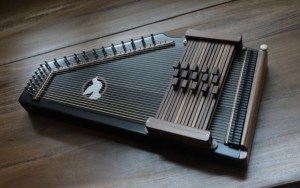 Walnut was the choice for the bridges, chord bars, chord bar buttons, bar comb covers, and tailpiece. Along with the brass hardware it makes for a subtle contrast to the solid black body.
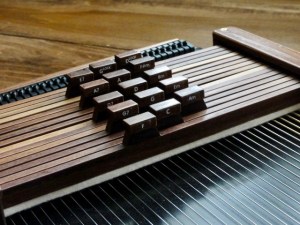
 The thirty-seven strings are anchored at the tail end with a set of Daigle Flatline fine tuners. Each string can be fine tuned by turning its allen screw with a small wrench. This is especially useful with a diatonic autoharp that has several string pairs that need to be tuned in unison and beatless. Fine tuners are also helpful for tweaking the strings that go a little sharp or flat from day to day environmental changes in temperature and humidity.


You must be logged in to post a comment.