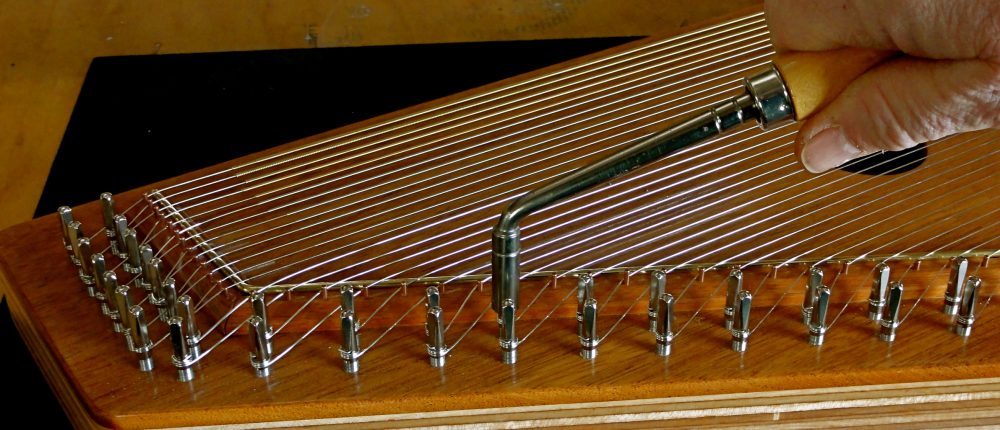
 I have recently completed three of my 3/4-size autoharps that are for sale and will soon be ready for delivery.
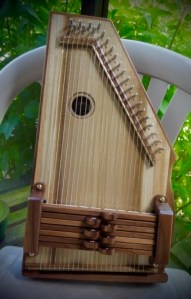
About two years ago I began building these smaller sized autoharps aimed at younger learners beginning their autoharp journey. I saw a need for a serious alternative to the painted “toys” produced by manufacturers in the past. With twenty-three strings and seven chords, my Child ‘Harps are lighter and easier to tune and play than their larger siblings.
They measure eighteen inches long, ten inches wide, and weigh under five pounds. Due to their smaller size and handmade quality, Child ‘Harps have also become attractive to adults who find them less stressful and fatiguing than playing larger, heavier autoharps. Having standard string and chord button spacing, they are ideal for the adult player adapting to a smaller instrument or the young learner who will eventually grow into a big autoharp.
 The design and construction is fundamentally the same as my full sized instruments. For structural integrity and tuning stability I build with one- piece laminated frames, and solid wood soundboards and components. They have a rich full voice for their size and are built to last.
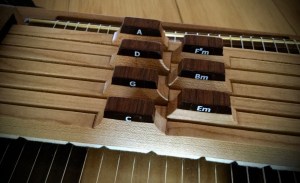
Chords in the keys of G and D.
Child ‘Harps come in two different two-key diatonic setups, each with seven chords. Being diatonic means that the string array doesn’t include all the notes in the chromatic scale but only the notes needed in the two keys. The G/D ‘harp plays in the keys of G and D and has four major chords (C, G, D, and A) and three minor chords (Em, Bm, and F#m). The F/C ‘harp plays in the keys of F and C and has four major chords (Bb, F, C, and G) and three minor chords (Dm, Am, and Em). The scale is similar to the mid and treble range found in standard autoharp tuning with the lowest note in the 3rd octave and the highest in the 6th octave. Unlike standard diatonic autoharps, these do not have doubled string courses.

Chords in the keys of F and C.

SOLD SOLD SOLD Child ‘Harp with walnut trim and solid poplar soundboard. Complete and ready for stringing and setup in buyer’s choice of either keys of F/C or G/D.
I try to make each of my instruments unique in some way so these three new ones are built using different wood combinations and tuning setups. Each is for sale and include a quilted “cozy” and a star tipped T-wrench for tuning.
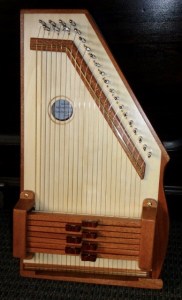
Twenty-three string, seven chord diatonic plays in the keys of F and C. African mahogany trim with an aspen soundboard.
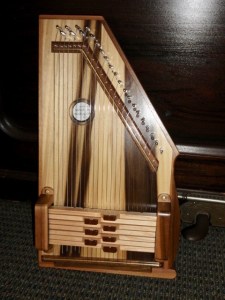
Twenty-three string, seven chord diatonic plays in the keys of G and D. Walnut trim with poplar soundboard
 I realize that the title of this post is kind of a stretch but it’s embarrassingly indicative of how my mind sometimes works. “My Name Is Morgan But It Ain’t J.P.” is an old time song that was covered by The New Lost City Ramblers. Mike Seeger, a member of the trio, famously owned and played an autoharp (not on that song) built by Tom Morgan of Morgan Springs, Tennessee. It was in admiration of Mike Seeger’s Morgan autoharp that prompted an Ohio musician to obtain the one I’m about to describe.
 Long story short…. this beautiful instrument arrived in 1980 fully finished but absent the chord bars. For various reasons Mr. Morgan could not complete the chord set but instead sent along sufficient rough stock of Brazilian rosewood for their fabrication. The instrument has slumbered peacefully and unplayed for over forty years until it came to my workshop last October.
 There are several features that make this a very distinctive autoharp. The woods, spruce and Brazilian rosewood, were purchased by Mr. Morgan at auction from the C.F. Martin guitar company where they had been in storage since the 1940s. The one piece spruce soundboard carries two of Morgan’s trademark “f” holes and is carved into a gentle violin- like arch. Although I couldn’t observe them because of the size and location of the sound holes, there apparently exist an internal pre-stressed truss rod and tone bars that, with a stainless steel anchor end reinforcing plate, make this a very stable instrument.
 Although unplayed, the chromatic string set was forty years old and a little corroded. After much consideration it was decided to replace it with a scale designed for diatonic play in the keys of G and D. An optional F note replaces an F# in the scale to allow an F chord for play in the key of C. The chords were chosen based upon the songs that will be accompanied and extra stock was made into additional minor chords, two lock bars, and blank bars for future need.
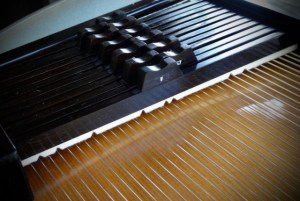 The twelve, 5/16 inch-wide chord bars are arranged in two rows as was probably the intention of the builder. They rest upon #6 steel pins driven into Delrin bases. The Seeger autoharp bore round buttons that were sometimes broken. These chord bars were fitted with comfortable dished trapezoidal buttons made of rosewood.
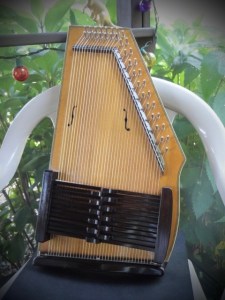 It was both an honor and a challenge completing this beautiful sounding instrument. Rosewood is a hard and oily wood that was not kind to tools and abrasives. I had some anxiety over making the most use of the limited and irreplaceable chord bar stock that was provided.
 Finally, after over forty years of initial correspondence with the instrument’s luthier Tom Morgan, weeks of consultation in my workshop, and even a global pandemic, the patient musician and his Morgan autoharp #80002 sing together.
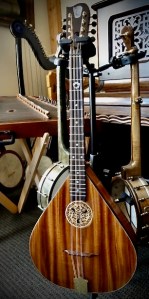 My most recent non-autoharp build is this eight string octave mandolin that I made for myself. The octave mandolin is commonly tuned to GDAE, one octave lower than its smaller cousins. With a longer 22-3/4 inch scale and eight strings, it lends a wonderful mellow voice to the Celtic music I love to play.
 The teardrop shaped body is made of book matched ribbon mahogany. The five piece neck of African mahogany, ebony, and birdseye maple is reinforced with a two-way adjustable truss rod. The fingerboard, peghead overlay, and heel cap are made of ebony and inlaid with mother of pearl. White/black/white purfling, black fiber binding, a herringbone back strip, and a laser cut rosette trim the body.


 As a luthier for 40+ years I have built hundreds of dulcimers and a great variety of other stringed instruments. In 2012, my first foray into the blogosphere was titled “Whatshebuildinginthere” in which I wrote about my instrument building with an emphasis on experimentation, information, and encouragement to help other musicians and builders. At some point autoharps took control so in 2016 I began this new blog calling it “fretorfretnot”. I expected to carry on blogging about both fretted and not fretted stringed instruments but again, autoharps ruled. Only lately have I found the time to pound frets instead of tuning pins.
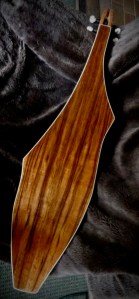

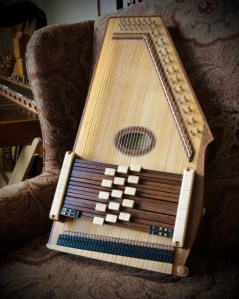 I recently completed and delivered this commissioned instrument to a musician in New York state. After the initial contact and much discussion by e-mail, the entire process required only three months. The wait probably seemed longer to the musician anxious to receive his first luthier built autoharp but its completion was well within my usual two to five month time estimate.

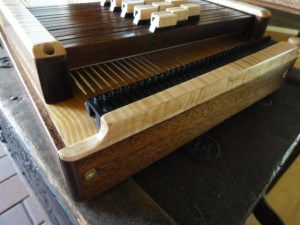 The chord bars, bridges, side veneer, chord bar covers, and tail cover are made of African mahogany stained with Minwax red mahogany oil stain. The chord bar covers, chord buttons, and tail cover are capped with curly maple finished natural. The soundboard is spruce, the back is maple veneer, and everything is finished with up to six coats of semi-gloss Deft lacquer.
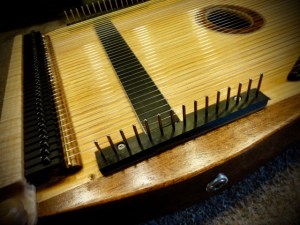 The Schreiber electromagnetic pickup is specially wound for this thirty-seven string array and is fastened underneath the chord bars by metal tabs that fit in slots on the underside of the Delrin chord bar combs. A small length of coax is routed through the inside of the instrument to a 1/4″ jack.
 Many of my autoharps are shipped out of state and abroad to musicians who will likely want to experiment with alternative chords or attend to future DIY adjustments and repairs. For this I include some extra blank felted chord bars, extra chord felt, self adhesive under cover felt, and extra springs. The wrapper from the custom string set will help them order the proper strings when it becomes necessary and a laminated strip indicates the tuning of each string. Also included is the allen wrench that comes with the fine tuners and a new star tipped T-wrench.
 I have always maintained my own instruments, mostly out of economic necessity but especially for the challenging DIY learning experience. This has led to a deeper understanding of what my instruments are capable of and how I might modify them to meet my personal needs. That has led to my forty plus years as a luthier, building and repairing a variety of stringed instruments.
 Plans for the Schmidt Model 73 are available for purchase from the Guild Of American Luthiers.
 Musicmakers offers a free download of plans and assembly instructions for their long discontinued “Autochord” kit and continues to sell the collated hardware to complete it. The Autochord differs somewhat in size and construction from other ‘harps but offers many helpful ideas. The file can be enlarged to full size at a retail copy center.
 The Autoharp Owner’s Manual includes excellent plans and instructions for building
 The best framing material for tuning and overall stability is the multi-laminated maple pin block manufactured for pianos. It grips tuning pins without cracking and remains stable in changing environmental conditions. It is particularly effective when cut as a single unit for the angled treble side, as it eliminates a troublesome joint that wants to creep. I like to cut the entire frame from a single blank so that there are no joints to fail. Pin block can be obtained from a piano technician or piano supply but the planks are fifty-nine inches long, so it’s unlikely that they would sell only enough for one ‘harp. Contact me to purchase a more economical size.
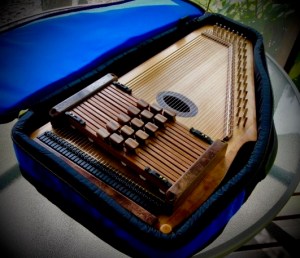
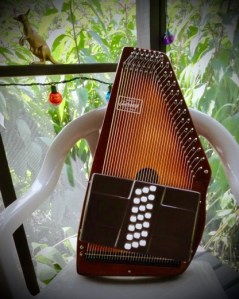 An autoharp musician and friend here in Ohio purchased this 21 chord Oscar Schmidt “Appalachian” from an online auction. He had been searching for this model for some time and was excited when this this instrument arrived in fair condition. Everything, including the plastic case, seemed to be original but worn and soiled from forty plus years of use. The felt was scored, the buttons were worn and discolored, and the strings were near the end of their life. The cherry colored finish had the usual nicks and thin spots, and visible inside the sound hole were some unacceptable glue runs and globs. Upgrading this autoharp to the level of the luthier built instruments that he currently owns and plays called for new strings, fine tuners, a new chord array, and a thorough cleanup.
 Twenty-one chord C models have an aluminium anchor bar that fits more or less snuggly in a pocket routed in the frame, and sometimes string tension exerts enough force to pull the bar forward and up. I replaced this with a fine tuner assembly made by
 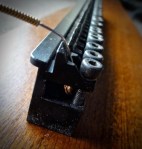 Another superior feature of the Schreiber fine tuners over the OS tuners is the flat bridge that keeps each string level regardless of how much the tuning cams are adjusted. The poorly designed OS cams raise and lower the individual strings causing inconsistent damping, making it necessary to periodically level and re-tune all of the strings.
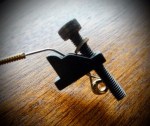 With this fine tuner assembly, each string is threaded through a small cam and secured to the anchor bar with an Allen screw and a washer. Fine tuning is achieved by turning the screws with a provided Allen wrench.
 After installing the fine tuners I replaced the old chrome anchor cover with laminated cherry stained to match the autoharp body.
 The original aluminium chord bars were felted with worn blocks and had discolored plastic buttons. Since the owner wanted a non standard chord array and a consistent button appearance, we opted for a new blank conversion kit that contained twenty-one blank bars, buttons, holders, and cover.
 The owner decided to keep the instrument chromatic and consulted with
  With new strings, hardware, and a more useful chord bar setup, the owner plans to share this good sounding autoharp and his favorite Mike Seeger songs with fellow students at the university where he attends.
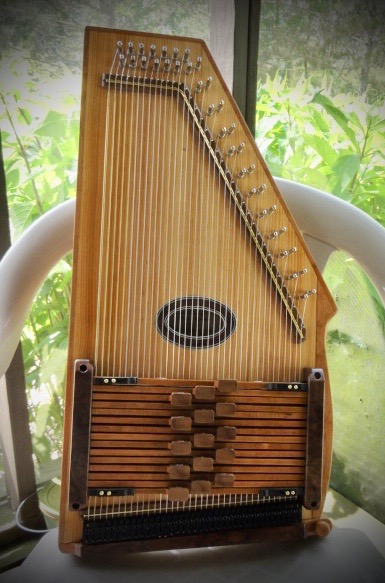 The latest from here at Fretnot Laboratories is this custom thirty-seven string, fifteen bar diatonic in the keys of G and D. It features Daigle fine tuners, two lock bars, flat chord bar buttons, and five extra blank chord bars for future substitutions. A custom oval rosette was fashioned using walnut burl and plastic white-black-white purfling. Walnut burl also trims the tops of the chord bar covers and the tail end cover.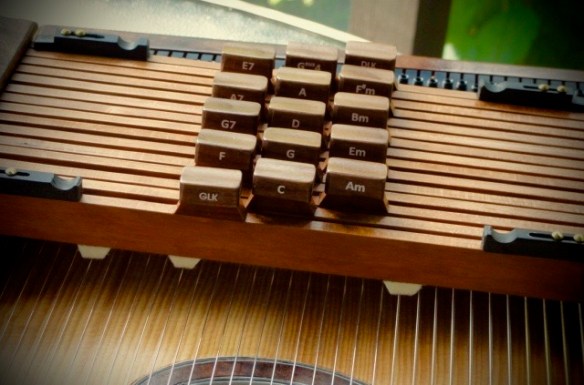
 Since introducing my new twenty-three string, seven chord child size autoharps two months ago, I received a lot of interest and positive comments. My goal was to produce a serious instrument for the young learner to play while growing into a standard, full size autoharp. I guess I wasn’t too surprised when several adults found them to be a good size as a travel instrument or for someone challenged by the size and weight of a more standard autoharp. At only eighteen inches long and weighing only four and one-half pounds, they are easy to hold and carry.

 Fret Or Fret Not
You must be logged in to post a comment.