 I realize that the title of this post is kind of a stretch but it’s embarrassingly indicative of how my mind sometimes works. “My Name Is Morgan But It Ain’t J.P.” is an old time song that was covered by The New Lost City Ramblers. Mike Seeger, a member of the trio, famously owned and played an autoharp (not on that song) built by Tom Morgan of Morgan Springs, Tennessee. It was in admiration of Mike Seeger’s Morgan autoharp that prompted an Ohio musician to obtain the one I’m about to describe.
 Long story short…. this beautiful instrument arrived in 1980 fully finished but absent the chord bars. For various reasons Mr. Morgan could not complete the chord set but instead sent along sufficient rough stock of Brazilian rosewood for their fabrication. The instrument has slumbered peacefully and unplayed for over forty years until it came to my workshop last October.
 There are several features that make this a very distinctive autoharp. The woods, spruce and Brazilian rosewood, were purchased by Mr. Morgan at auction from the C.F. Martin guitar company where they had been in storage since the 1940s. The one piece spruce soundboard carries two of Morgan’s trademark “f” holes and is carved into a gentle violin- like arch. Although I couldn’t observe them because of the size and location of the sound holes, there apparently exist an internal pre-stressed truss rod and tone bars that, with a stainless steel anchor end reinforcing plate, make this a very stable instrument.
 Although unplayed, the chromatic string set was forty years old and a little corroded. After much consideration it was decided to replace it with a scale designed for diatonic play in the keys of G and D. An optional F note replaces an F# in the scale to allow an F chord for play in the key of C. The chords were chosen based upon the songs that will be accompanied and extra stock was made into additional minor chords, two lock bars, and blank bars for future need.
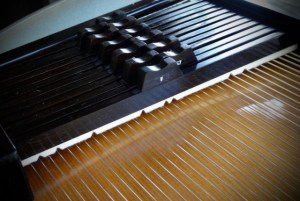 The twelve, 5/16 inch-wide chord bars are arranged in two rows as was probably the intention of the builder. They rest upon #6 steel pins driven into Delrin bases. The Seeger autoharp bore round buttons that were sometimes broken. These chord bars were fitted with comfortable dished trapezoidal buttons made of rosewood.
Since the owner requested that there would be no visible screws, I devised a means of anchoring each holder and its Delrin base together with only two invisible screws. To provide easy access to adjust and change out chord bars I made top covers held by internal and inlaid magnets.
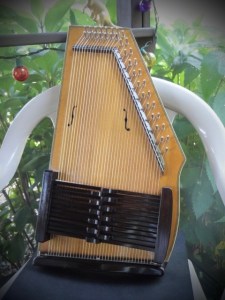 It was both an honor and a challenge completing this beautiful sounding instrument. Rosewood is a hard and oily wood that was not kind to tools and abrasives. I had some anxiety over making the most use of the limited and irreplaceable chord bar stock that was provided.
 Finally, after over forty years of initial correspondence with the instrument’s luthier Tom Morgan, weeks of consultation in my workshop, and even a global pandemic, the patient musician and his Morgan autoharp #80002 sing together.
 As a landlocked luthier here in Ohio, I truly miss the ocean. Marsha and I have lived in a coastal town on the Great Barrier Reef. We have wandered beaches in Florida, Cape Cod, Oregon, Nova Scotia, Iceland, and Ireland. We even spent two months at sea working on a container ship that crossed both Tropics and the Equator. With only some photos and a smattering of shells to sustain our fading memories, I sometimes regret leaving those experiences behind for life in the flatlands.
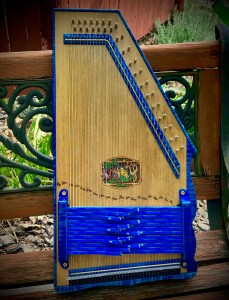
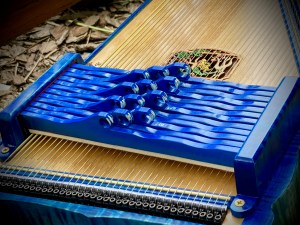 This thirty-seven string instrument has twelve chord bars shaped like waves. The three rows of buttons resemble white caps. Bridges, chord bar holders, tail cover, and side trim are made of curly maple dyed bright blue to show an iridescent, wave like grain.
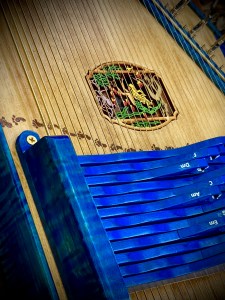
 A laser cut rosette adorns the sound hole and bare footprints cross the sandy colored solid spruce soundboard.
 The laminated back has been painted bright blue using netting as a stencil. Captured in this fish net is a colorful jellyfish soundhole.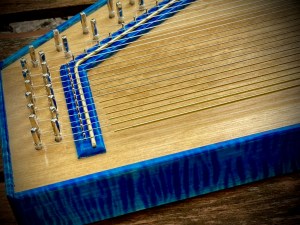
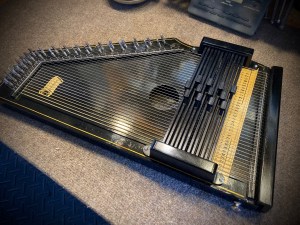 Recently, a musician from Louisiana sent me an “Old Black Box”, or rather, a thirty-six string, twelve chord Oscar Schmidt autoharp that was manufactured in 1958. As with many of these older “A” models purchased on-line, from families, or from estate sales, it was covered with dust and gunk. Still, it had possibilities so the owner had it polished and restrung with Schreiber “Old Model A” strings. It was sent to me in excellent condition for a couple of useful upgrades.
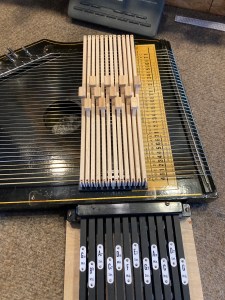 The owner learned to play the old way, below the chord bars. He also wanted to be able to play above the bars in the high treble area. To accomplish this I made chord bars 3/16 inches wide which made the chord set narrower. By repositioning the set in the center, there was now 1-1/2 inches above and 1-1/2 inches below the chord bars allowing play both ways.
 I tried to retain the aged/historical appearance by coloring the new chord bars and holders black and installing a used tuning pin to match the old ones.
 Here is a new custom thirty-seven string chromatic autoharp that I built for a beginning autoharp musician here in Ohio. She plans to play worship and folk music to accompany herself and other vocalists. Because she resides within easy driving distance to Darke County, she and her husband could visit, view the many features and options available, and order the special instrument that is to be a birthday gift from her family.
 I always try to make each of my instruments unique so that my clients have a special instrument unlike any other. Of course there are constraints like scale, setup, and structure, but I like to give folks choices. This musician chose a western red cedar soundboard, maple chord bars, and curly cherry for the bridges, bar holders, buttons, and side trim.
 A weeping heart was chosen for the sound hole. I made this by inlaying a 1/8″ thick cherry heart shape into the 1/4″ thick soundboard and then removing the inner heart shape leaving a 1/8″ wide cherry border.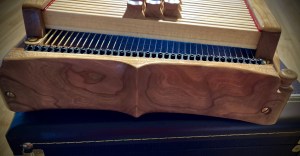
 The fifteen maple chord bars feature cherry buttons with the lateral dishing (rather than longitudinal dishing) preferred by the player. They move on #6 steel pins set into Delrin bases. The chord felt is yet uncut pending the player’s preferences.
 Structurally, this A style autoharp is built with a one piece laminated pinblock frame and a 1/4″ thick laminated birch back. Lately, I have been routing away unnecessary areas inside the frame to increase the interior volume. This, along with some tuned bracing, improves tone and volume.
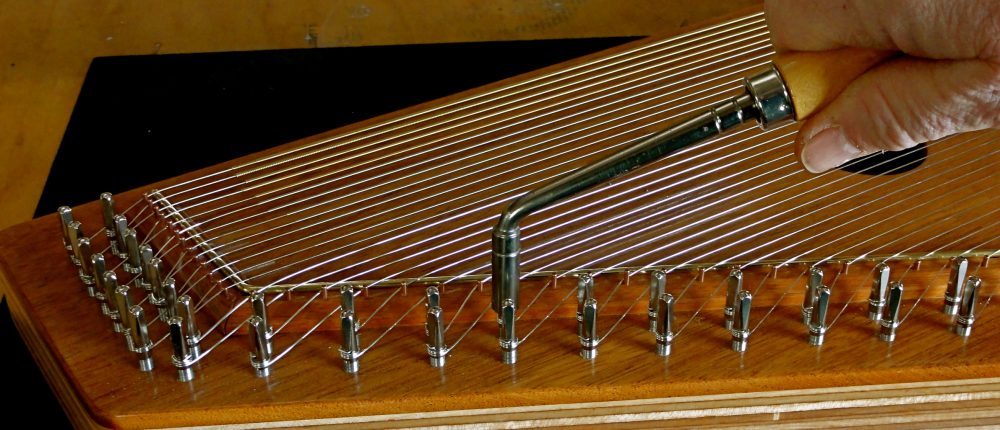
 Hex screws are components of autoharp fine tuners. They are adjusted with some form of a hex key that is usually supplied with the assembly. This necessary implement is usually stored in the case, pick bag, or somewhere in that room you just walked into but forgot why.
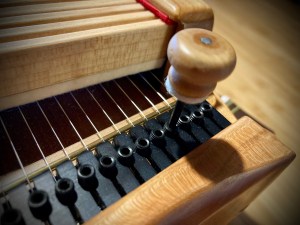 …………..where it’s right at hand for quick tuning touch ups.
 Many autoharps, especially manufactured ones, have decals, stickers, or note labels to designate the pitch of each string. These are unsightly and mostly unnecessary once the autoharp has attained a stable tuning. Some musicians convert their instruments to an alternative tuning such as a diatonic setup with a completely different tuning schedule that is no longer supported by the existing labels.
 I printed a tuning chart that I glued to a thin strip of wood. This can be slipped under the strings when needed as a reference for tuning each string.
 On the reverse side of the tuning strip is red felt. It prevents the wooden strip from scratching the soundboard and doubles as a convenient tool to remove dust under the strings.
 During the early pandemic shut down and the following months, I restricted my piano work to the large spaces of churches at times when no one else was present. Only recently, since my three Covid vaccinations, have I resumed working in private residences. Catching up on nearly a year’s work has seriously cut into my workshop time. For that reason I have had a dream of taking on a few employees to ease my workload.
 And a dream it was! As I slept, a small crew (elves?) assisted me with some of the more tedious tasks of autoharp construction. Alas, they had disappeared by morning, never to return. I would like to believe that they responded to some of the many help wanted signs posted in our area and found employment with fair compensation, benefits, and a living wage for their important work.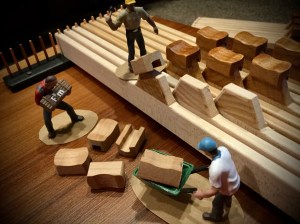
 I recently completed is this thirty-seven string diatonic autoharp in the single key of A. I built it for ourselves because Marsha and I are trying to sing along with our instruments more and find that the key of A is a comfortable range for our voices. Being a single key diatonic, it has paired string courses in the middle octave and only the notes needed for chords in the key of A. This produces a very rich and full tone that works nicely for strumming accompaniment and playing melody.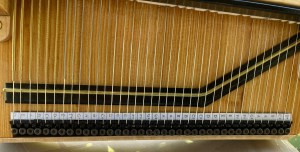
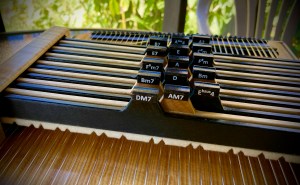 Fifteen chords are arranged in a “Bowers” type setup with major chords in the center row, sevenths in the top row, and minors in the bottom row. This familiar arrangement is in place on all of Marsha’s instruments and permits a sort of “motor memory” to kick in when she changes from one autoharp to another, even if in different keys. Seven of the chords are “color chords” for enhanced arrangements.
 The instrument has a 1/4 inch thick solid spruce soundboard. The one piece frame is laminated maple pinblock with a laminated maple back. The side veneer, end cover, and chord bar covers are made of curly maple. Chord bars are maple with alternate bars painted black. Black tuning pins, bridges, Schreiber fine tuners, and purfling complete the black/white motif.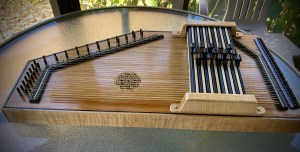
 My most recent instrument is this custom chromatic autoharp commissioned by a musician here in Ohio.
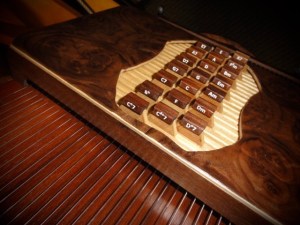 The twenty-one maple chord bars are capped with walnut buttons and are mounted upon combs made of #6 bridge pins and Delrin bases. Just to be different, I kinda hybridized the chord bar covers by making a shell out of walnut and very thin birch plywood. Its top surface is veneered with sequence-matched walnut burl. There is no distinct advantage for making it this way but the larger areas of felt damping on the underside seem to make the chord bars quieter.
 The side trim and bridges are walnut.
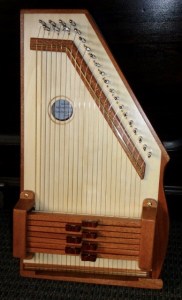
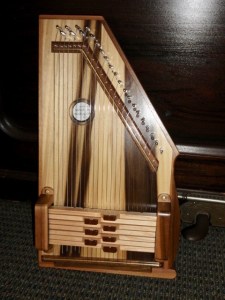
 I have recently completed three of my 3/4-size autoharps that are for sale and will soon be ready for delivery.
 The design and construction is fundamentally the same as my full sized instruments. For structural integrity and tuning stability I build with one- piece laminated frames, and solid wood soundboards and components. They have a rich full voice for their size and are built to last.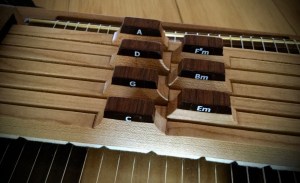




You must be logged in to post a comment.