 As a luthier for 40+ years I have built hundreds of dulcimers and a great variety of other stringed instruments. In 2012, my first foray into the blogosphere was titled “Whatshebuildinginthere” in which I wrote about my instrument building with an emphasis on experimentation, information, and encouragement to help other musicians and builders. At some point autoharps took control so in 2016 I began this new blog calling it “fretorfretnot”. I expected to carry on blogging about both fretted and not fretted stringed instruments but again, autoharps ruled. Only lately have I found the time to pound frets instead of tuning pins.
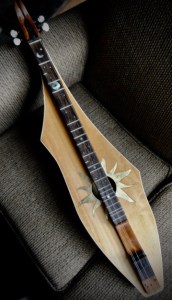
This mountain dulcimer was commissioned by a musician (Marsha) that has always played in the Ionian tuning of DAA instead of the more conventional and contemporary tuning of DAD. The DAA tuning has been traditionally used for “noter and drone” playing, that is, fretting the melody on the closer “A” string/s with a stick called a noter and allowing the middle “A” string and the lower “D” string to drone. Instead, this musician fingers chords and melody on all three string courses and uses a capo or re-tunes to play in other keys and modes. To the inexplicable astonishment of many dulcimer musicians who tune and play in DAD tuning, DAA tuning can play the same music, just using different fingering patterns.

The 1-1/2 and 8-1/2 (not shown) frets are partial frets installed under only the melody string/s
A few additions have been made to favor versatility. The 6-1/2 fret has been added to the scale for Mixolydian (or DAD) tuning. Partial frets at the 1-1/2 and 8-1/2 positions were installed under the melody course to add the extra note used in Mixolydian tunes and capoed play. Many players who tune to DAD add a full fret to the 1-1/2 position but we find it confusing and unnecessary for DAA tuning. Playing some faster melodies in DAA requires long travel up and down the fretboard and some wide finger stretches when playing chords. For that purpose a more comfortable 26-3/8″ scale length was chosen over the slightly longer scale of her other dulcimers. This small difference in scale length places the frets closer together making it easier to span chords and play faster.
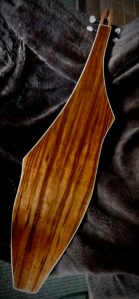
The back and sides are Koa wood trimmed with grained ivoroid binding.
A western cedar soundboard, koa back and sides, wenge fretboard overlay, and mahogany fingerboard and peghead make up the body of the instrument. The four tuning machines are black chrome Gotoh planetary tuners with grained ivoroid buttons. Grained ivoroid binding trims the top and back and provides some protection from the inevitable boo-boos that attack the vulnerable edges.
Sun, Earth, Moon, and stars create a basic theme with an asymetrical shape, cutouts in the peghead, and simple pearl and abalone inlays.
The sun on the soundboard was created by first shallowly routing the shape on the cedar top and then applying gold leaf. The gold leaf isn’t actually gold but brass that comes in unbelievably thin 5.5″x5.5″ sheets. Handling this material that is only a few molecules thick is tricky. It easily tears at the slightest attempt to move it. Fortunately I could overlap the fragments without visible seams. Application took some practice and involved applying a sizing (glue) and then burnishing on the thin brass. This and the rest of the instrument was finished with multiple coats of semi-gloss Deft lacquer.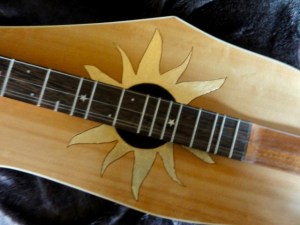

Clip-on electronic tuners are very popular with stringed instrument musicians. They assist accurate tuning even in noisy jam sessions because they “hear” the vibrations that are conducted through the clip attachment. Many styles are available but finding a convenient and reliable place to attach them on some instruments is frustrating. For this dulcimer I removed the clip from a D’Addario tuner and replaced it with a short length of 1/8″ Delrin rod. The small star in the peghead was the perfect place to conceal an 1/8″ hole for the tuner which can be inserted and removed as needed.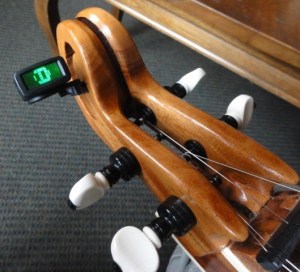
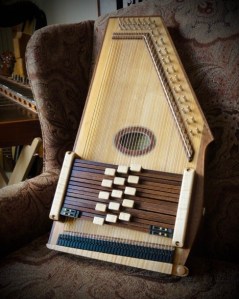 I recently completed and delivered this commissioned instrument to a musician in New York state. After the initial contact and much discussion by e-mail, the entire process required only three months. The wait probably seemed longer to the musician anxious to receive his first luthier built autoharp but its completion was well within my usual two to five month time estimate.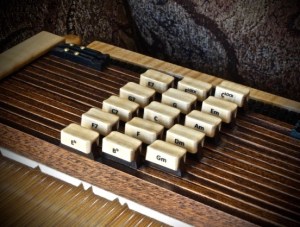

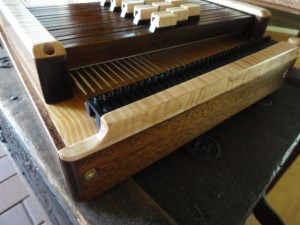 The chord bars, bridges, side veneer, chord bar covers, and tail cover are made of African mahogany stained with Minwax red mahogany oil stain. The chord bar covers, chord buttons, and tail cover are capped with curly maple finished natural. The soundboard is spruce, the back is maple veneer, and everything is finished with up to six coats of semi-gloss Deft lacquer.
 The Schreiber electromagnetic pickup is specially wound for this thirty-seven string array and is fastened underneath the chord bars by metal tabs that fit in slots on the underside of the Delrin chord bar combs. A small length of coax is routed through the inside of the instrument to a 1/4″ jack.
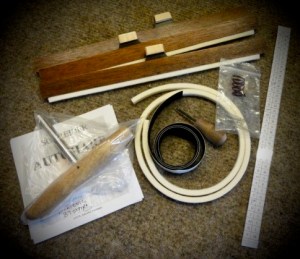 Many of my autoharps are shipped out of state and abroad to musicians who will likely want to experiment with alternative chords or attend to future DIY adjustments and repairs. For this I include some extra blank felted chord bars, extra chord felt, self adhesive under cover felt, and extra springs. The wrapper from the custom string set will help them order the proper strings when it becomes necessary and a laminated strip indicates the tuning of each string. Also included is the allen wrench that comes with the fine tuners and a new star tipped T-wrench.
 I have always maintained my own instruments, mostly out of economic necessity but especially for the challenging DIY learning experience. This has led to a deeper understanding of what my instruments are capable of and how I might modify them to meet my personal needs. That has led to my forty plus years as a luthier, building and repairing a variety of stringed instruments.
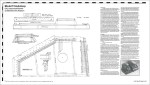 Plans for the Schmidt Model 73 are available for purchase from the Guild Of American Luthiers.
 Musicmakers offers a free download of plans and assembly instructions for their long discontinued “Autochord” kit and continues to sell the collated hardware to complete it. The Autochord differs somewhat in size and construction from other ‘harps but offers many helpful ideas. The file can be enlarged to full size at a retail copy center.
 The Autoharp Owner’s Manual includes excellent plans and instructions for building
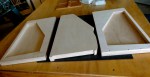 The best framing material for tuning and overall stability is the multi-laminated maple pin block manufactured for pianos. It grips tuning pins without cracking and remains stable in changing environmental conditions. It is particularly effective when cut as a single unit for the angled treble side, as it eliminates a troublesome joint that wants to creep. I like to cut the entire frame from a single blank so that there are no joints to fail. Pin block can be obtained from a piano technician or piano supply but the planks are fifty-nine inches long, so it’s unlikely that they would sell only enough for one ‘harp. Contact me to purchase a more economical size.
 An autoharp musician and friend here in Ohio purchased this 21 chord Oscar Schmidt “Appalachian” from an online auction. He had been searching for this model for some time and was excited when this this instrument arrived in fair condition. Everything, including the plastic case, seemed to be original but worn and soiled from forty plus years of use. The felt was scored, the buttons were worn and discolored, and the strings were near the end of their life. The cherry colored finish had the usual nicks and thin spots, and visible inside the sound hole were some unacceptable glue runs and globs. Upgrading this autoharp to the level of the luthier built instruments that he currently owns and plays called for new strings, fine tuners, a new chord array, and a thorough cleanup.
 Twenty-one chord C models have an aluminium anchor bar that fits more or less snuggly in a pocket routed in the frame, and sometimes string tension exerts enough force to pull the bar forward and up. I replaced this with a fine tuner assembly made by
  Another superior feature of the Schreiber fine tuners over the OS tuners is the flat bridge that keeps each string level regardless of how much the tuning cams are adjusted. The poorly designed OS cams raise and lower the individual strings causing inconsistent damping, making it necessary to periodically level and re-tune all of the strings.
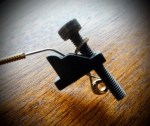 With this fine tuner assembly, each string is threaded through a small cam and secured to the anchor bar with an Allen screw and a washer. Fine tuning is achieved by turning the screws with a provided Allen wrench.
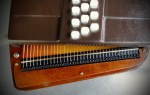 After installing the fine tuners I replaced the old chrome anchor cover with laminated cherry stained to match the autoharp body.
 The original aluminium chord bars were felted with worn blocks and had discolored plastic buttons. Since the owner wanted a non standard chord array and a consistent button appearance, we opted for a new blank conversion kit that contained twenty-one blank bars, buttons, holders, and cover.
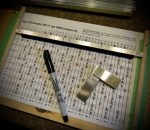 The owner decided to keep the instrument chromatic and consulted with
  With new strings, hardware, and a more useful chord bar setup, the owner plans to share this good sounding autoharp and his favorite Mike Seeger songs with fellow students at the university where he attends.
 The latest from here at Fretnot Laboratories is this custom thirty-seven string, fifteen bar diatonic in the keys of G and D. It features Daigle fine tuners, two lock bars, flat chord bar buttons, and five extra blank chord bars for future substitutions. A custom oval rosette was fashioned using walnut burl and plastic white-black-white purfling. Walnut burl also trims the tops of the chord bar covers and the tail end cover.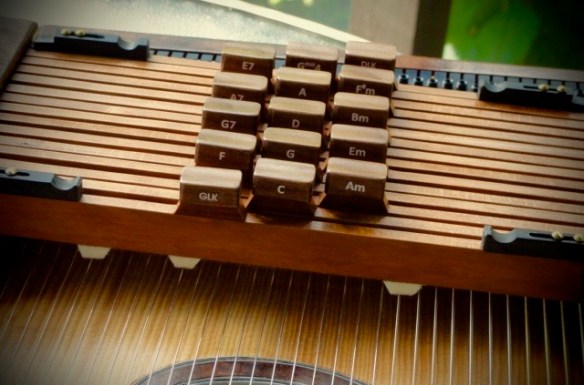

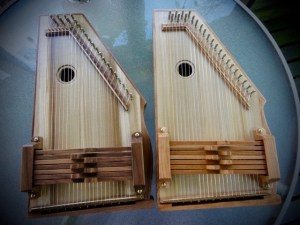 Since introducing my new twenty-three string, seven chord child size autoharps two months ago, I received a lot of interest and positive comments. My goal was to produce a serious instrument for the young learner to play while growing into a standard, full size autoharp. I guess I wasn’t too surprised when several adults found them to be a good size as a travel instrument or for someone challenged by the size and weight of a more standard autoharp. At only eighteen inches long and weighing only four and one-half pounds, they are easy to hold and carry.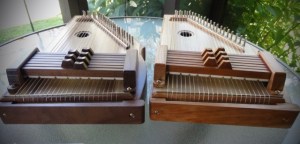
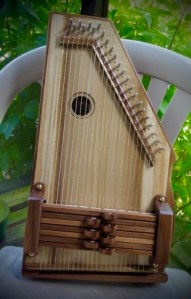
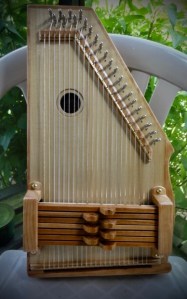
 Several years ago they produced their version of an autoharp and called it an “Autochord”. It was a unique design that differed from the more conventional Chromaharps and Oscar Schmidts. Thirty-eight ball end guitar strings spanned from bridge pins to an anchor end bridge made from a section of brass tubing. The chromatic tuning was scheduled from F2 to A5. The fifteen chord bars rested upon 1/8 Delrin rods drilled directly into the soundboard. The body of the instrument consisted of a 1/4″ redwood soundboard with a bass bar, a 3/8″ plywood back, and a laminated frame with gaps at each end of the long rail.
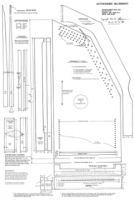 This interesting instrument was offered as an easy to assemble kit for someone with basic DIY skills. Like all of Musicmakers kits, it would, with attention to detail, bring satisfying results. The result however, was a rather large, heavy, and somewhat unconventional autoharp.
 This Autochord kit came to my workshop in the original shipping carton. It was purchased in 1995 and had only the soundboard and back glued to the frame. The current owner asked me to complete it and install fine tuners.
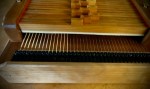 I made several modifications to the original design. The Daigle fine tuner system came with its own bridge so I deleted the kit’s brass tube. The wound bass strings supplied were standard guitar strings that had windings their entire length. Greg Schreiber made a custom set of wound strings that had windings only within the speaking length of the strings. I substituted threaded adjustable bridge pins so I could accurately level the strings for effective damping.
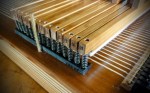 The design specified drilling the Delrin chord bar combs directly into the soundboard. Instead, I made separate Delrin bases that can be more easily adjusted for smoother chord bar movement.
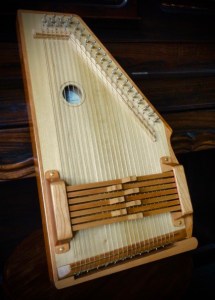 With that in mind, I present my own iteration of a child size autoharp designed as a serious, good sounding, and well built instrument for the young learner. I believe that a quality, attractive, and stable instrument with standard string spacing, and a logical chord bar setup will make it easier to learn and to later grow into a standard autoharp. My aim is to produce a smaller scale instrument for fun as well as serious study and not a colorful toy of passing interest.

 The high quality Schreiber custom string set is specially gauged for a string schedule tuned: G-C-F-G-A-B-C-D-E-F-G-A-A#-B-C-D-E-F-G-A-A#-B-C.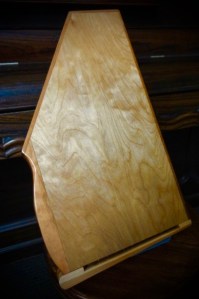
 At this time the only option I can offer is the choice of woods for the side veneer, chord set, bridges, and end cover. This prototype is cherry but other choices include walnut, maple, and mahogany. In the future I plan to add greater customization and alternate chord setups with more chords in two or three rows.
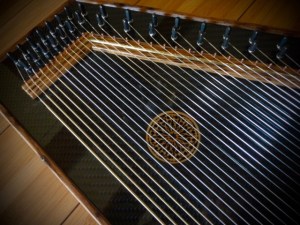 With few exceptions, autoharps have been made of wood. Solid and laminated hardwood frames have been enclosed by hardwood, softwood, and plywood with the builder’s and player’s personal preferences guiding the combination. Decades of research and experimentation with natural materials have led to construction techniques for building good sounding and structurally stable instruments but swings in temperature and humidity persist in causing cracks, bulges, separations, tuning instability and even implosions. Temperature control, humidifiers in the winter, dehumidifiers in the summer, and fine tuners all help us avoid adverse environmental effects but, as careful as we are, there can be some disappointing surprises. Could there be a material that’s very stable and sounds good? Carbon fiber may be the answer.
 Carbon fiber, a very strong and rigid composite material, has been used successfully to build musical instruments for many years. The first luthier to utilize this material in sheet form for autoharp construction was Pete Daigle of Daigle Autoharps in Seattle, Washington.
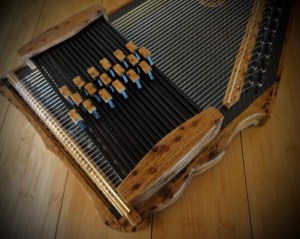 My recent interest in trying carbon fiber has taken the form of this new thirty-seven string chromatic. With my one piece laminated frame and back and a carbon fiber soundboard, I’m hoping that this buggy will never crash and the only maintenance necessary will be the occasional tune-up and maybe a couple of future brake jobs.
 I ordered a 12″x24″x1/8″ blank sheet of carbon fiber from the DragonPlate company in Elbridge, NY. The purchase cost and machining labor was about five times greater than that of making a comparable wooden top.
 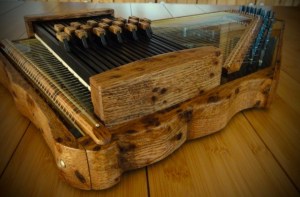 The 1/4″ side veneer, tailpiece, and chord bar holders are made of red oak with an interesting “bark intrusion”. The eighteen maple chord bars are lacquered black and the buttons have been randomly burnt with a mini torch to resemble the oak trim.
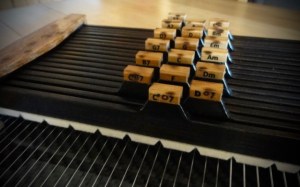 The standard chromatic tuning schedule includes a thirty-seventh string tuned to D6. The eighteen thin chord bars are carried by steel pins driven into Delrin bases. The three row setup favors the keys of C, G, and D and includes the Cdim7th, C#dim7th, and Ddim7th chords.
 To access the chord bars for adjustment or change I made magnetic holder covers that can be easily popped open without removing screws. The caps are aligned with tiny pins at each end and held fast in the center by small rare earth magnets. Self adhesive felt strips on the underside of the caps quietly adjust the chord bars’ height for a low playing action.
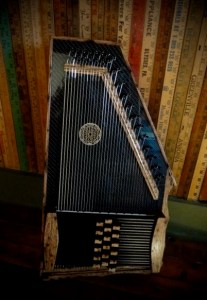 So, how does this carbon fiber sound? For us, it is too soon to say anything other than “different”. Folks who play the Daigle carbon fiber harps report that they are loud, bright, and have a “crazy amount of sustain”. It does seem louder than our other instruments but we need a “breaking in” period before we can assess its tone, articulation, and presence. Almost as important is the expectation of greater structural stability and the attractive visual combination of carbon fiber and red oak.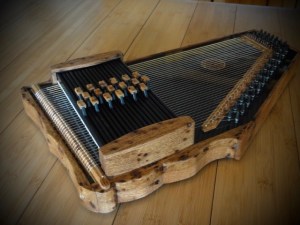



 Fret Or Fret Not
You must be logged in to post a comment.